


AI in Threat Intelligence: 10 Platform Features That Matter in 2026

Ask a CTI analyst what they need most. The answer is rarely more data. It is more hours in the day.
The typical analyst starts the morning with thousands of new indicators. Behind them wait vendor reports and a dozen advisories from peers and agencies. Most of it is duplicated, outdated, or irrelevant to the business. Somewhere in that pile sits the one signal that matters.
The 2026 SANS Cyber Threat Intelligence Survey shows the gap. It found that 91% of CISOs value threat intelligence, but only 26% say it drives decisions. Meanwhile, the Verizon 2026 Data Breach Investigations Report found that 31% of breaches start with vulnerability exploitation.
Used well, AI closes that gap by doing the reading, sorting, and connecting that fills an analyst's week. Used poorly, it adds a chatbot to the same old workflow.
A threat intelligence platform (TIP) collects, enriches, and shares threat data. An AI-powered threat intelligence platform uses machine learning, generative AI, and agents to do that work faster. Every TIP now claims AI, but far fewer can show how it works and who stays in control.
This guide covers the AI features that matter across the cyber threat intelligence lifecycle. Each section explains one feature, and a closing section lists the questions to ask vendors. For a broader framework, see the Threat Intelligence Platform Buyer's Guide.
The 10 AI features to look for in a threat intelligence platform:
Automated intel ingestion and IOC extraction
Automated enrichment and summarization
Natural-language query and investigation
Risk-based scoring and IOC lifecycle management
Threat actor profiling and MITRE ATT&CK mapping
Early-warning signals and exposure correlation
Agentic threat hunting and orchestration
AI-assisted detection engineering
AI-powered intel sharing and collaboration
Trust, transparency, and AI governance
This list draws on Gartner's Feeds to Agents research and the 2026 SANS CTI Survey. It also reflects common TIP evaluation questions.
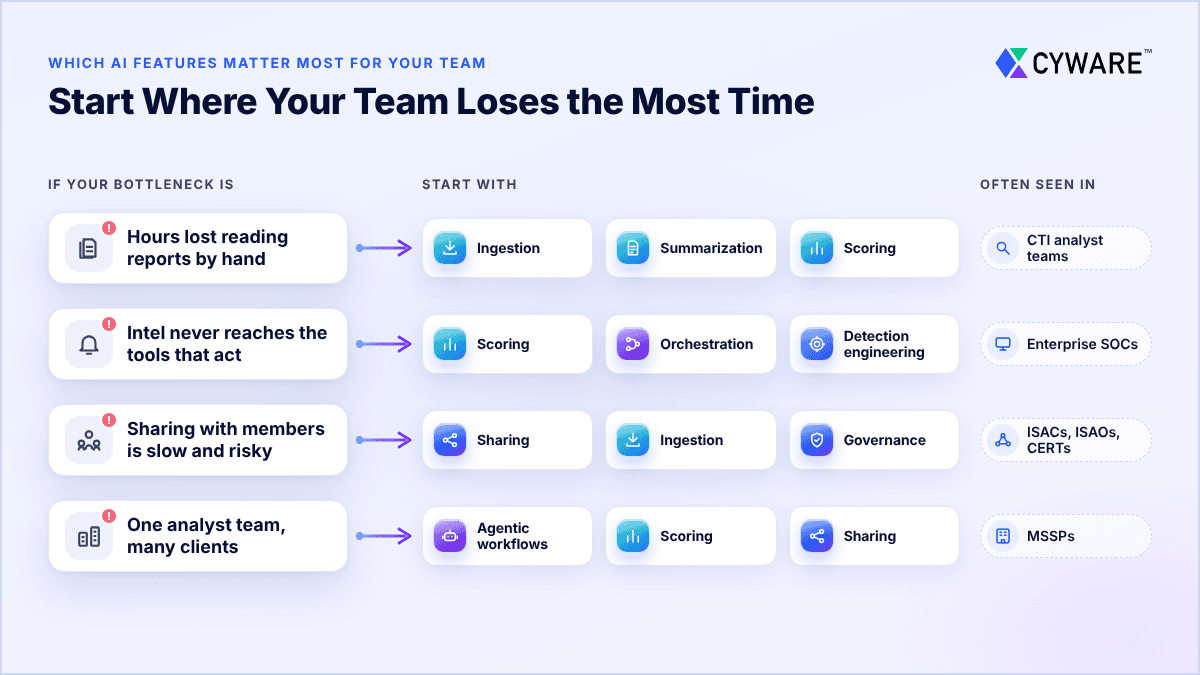
Which AI Features Matter Most for Your Team
Not every team needs all ten features on day one. A good start is finding the ones that match how your team works day-to-day.
Team profile | Start with | Why |
Threat Intelligence Analysts | Ingestion, summarization, scoring | Removes the manual work that eats most analyst hours |
Enterprise SOC | Scoring, orchestration, detection engineering | Puts vetted intel into the tools that act on it |
ISAC, ISAO, or CERT | Sharing, ingestion, governance | Makes safe, two-way sharing fast for every member |
MSSP | Agentic workflows, scoring, sharing | Scales one analyst team across many clients |
1. Automated Intel Ingestion and IOC Extraction
Core value: AI reads threat intel in any format and turns it into structured data. Every other AI feature depends on this clean foundation.
Threat intel arrives as threat intelligence feeds, CSV exports, PDF reports, vendor blogs, ISAC emails, and forum posts. Traditional platforms handle structured feeds well. The rest usually lands on an analyst, who copies indicators into a spreadsheet by hand.
That is costly. The 2026 SANS CTI Survey found most formal CTI teams have fewer than four full-time staff. Lack of time is a top barrier for 44% of respondents.
Extraction targets two kinds of data. An indicator of compromise (IOC) is an observable artifact associated with potentially malicious activity. NIST defines IOCs as technical artifacts suggesting an attack is imminent, underway, or has already occurred.
Tactics, techniques, and procedures (TTPs) describe how an attacker operates. MITRE ATT&CK catalogs them, for example OS Credential Dumping (T1003). Attackers swap IOCs easily, but TTPs change slowly, so a good extractor captures both.
A modern TIP should read unstructured content like an analyst and pull out:
IP addresses, domains, URLs, file hashes, and registry keys
CVEs and malware families
Threat actors and the TTPs they use
It should then normalize everything into STIX and merge duplicates. The same indicator from five sources becomes one record with five sources behind it.
That last step matters more than it sounds. Deduplication turns "we have 40 feeds" into "we know which feeds tell us something new." For help choosing sources, see the best threat intelligence feeds in 2026.
Quick Add Intel: Analysts drop in a file, URL, or text, and AI extracts indicators, vulnerabilities, and TTPs for review. Intel arriving as STIX, MISP, CSV, YARA, PDF, or free text is deduplicated and normalized to STIX 2.1. The AI Threat Intel Crawler browser extension structures web-based intel in under 10 seconds.
Once the data is in and clean, the next problem is making sense of it.
2. Automated Enrichment and Summarization
Core value: Enrichment adds context to every indicator, and generative AI condenses long reports into short, readable briefs.
An IP address on its own tells you almost nothing. Is it a known command-and-control server? A shared cloud host? Part of a campaign against your industry last month?
Enrichment answers those questions by checking each indicator against reputation services, sandboxes, WHOIS, DNS, and past sightings. It is a core building block of unified threat intelligence management.
Generative AI adds a second layer, summaries, and this is where most teams start with AI. The 2026 SANS CTI Survey found that 45% of organizations already use AI in CTI. Most use it for data summarization and report writing.
A 40-page vendor report becomes a short brief on who is behind it and what to look for. For leadership, a week of technical findings becomes a plain-language board update.
The catch is accuracy, so every claim in a summary should point back to its source.
AI Summaries: Reports and related indicators are condensed into briefs in seconds. Enrichment from sources such as VirusTotal, Mandiant, and PolySwarm is weighted by source credibility. The Threat Briefing Agent delivers scheduled briefings on the threats relevant to your organization.
Summaries help analysts read faster, but they also need a faster way to ask questions.
3. Natural-Language Query and Investigation
Core value: Analysts ask questions in plain English and get answers backed by the underlying records.
For years, getting answers from a TIP meant learning its query language. Only the power users could reach the most useful intel.
Natural-language query removes that barrier, so an analyst can simply ask questions like these:
"Which ransomware groups targeting healthcare used phishing in the last 90 days?"
"Have we seen any indicators linked to this actor in our environment?"
The platform translates the question, searches its data, and returns an answer with supporting records.
During an investigation, the analyst can pivot from an IP to a domain to an actor in seconds. Junior analysts get productive faster, and senior analysts spend less time on lookups.
Above all, answers must be grounded in your platform's data and cited. A confident answer with no source is worse than no answer.
Better questions surface more threats, so the next step is deciding which come first.
4. Risk-Based Scoring and IOC Lifecycle Management
Core value: Scoring ranks intel by relevance to your organization. Lifecycle management ages out stale indicators so they stop firing false alerts.
Not every threat is your threat. A banking trojan aimed at retail customers elsewhere may be real, but not yours.
Relevance starts with Priority Intelligence Requirements (PIRs), the questions your CTI program must answer. Without them, "relevant" has no definition, and scoring falls back to generic severity. The Relevance Doctrine series explains how PIRs turn relevance into daily practice.
Good AI scoring weighs several signals at once:
Source reliability and how many sources agree
How recently the indicator was seen
Whether it targets your industry or region
Whether it touches technology you run
Vulnerability intel works the same way. In the 2026 SANS CTI Survey, 79% named actively targeted vulnerabilities as a top priority. CISA's Known Exploited Vulnerabilities (KEV) catalog lists flaws attackers are actively using. The Verizon 2026 DBIR found only 26% of critical KEV vulnerabilities were fully remediated.
Exploit likelihood scores such as FIRST's EPSS help here. An exploited CVE in your stack should jump ahead of a higher-rated CVE nobody uses.
Scoring must also change over time, because an IP that hosted malware may host a harmless site today. If old indicators never expire, they keep blocking legitimate traffic. A modern TIP should age indicators, lower their scores, and retire them automatically.
Risk Score Engine: Teams weight sources and attributes, then test strategies in a built-in simulator. Decay periods are set per indicator type, and the PIR Agent turns plain-language requirements into tracked PIRs. The Vulnerability Exposure Analysis Agent matches CVEs against asset data to flag real exposure.
With priorities set, analysts can look at the bigger question: who is behind the activity?
5. Threat Actor Profiling and MITRE ATT&CK Mapping
Core value: AI links indicators to known actors and campaigns, then maps their behavior to MITRE ATT&CK techniques.
Indicators change by the hour, while attacker behavior changes far more slowly. That is why mature teams track the groups behind the activity, not just their IPs and hashes. In the 2026 SANS CTI Survey, 77% ranked adversary TTPs as a top priority.
The scale is large: MITRE ATT&CK documents 182 named threat groups, many with several aliases.
To build those profiles, AI links new indicators to known actors and merges aliases into one profile. It groups related campaigns and maps behavior to ATT&CK techniques. Over time, the platform builds a living picture of who each actor targets and how.
ATT&CK mapping makes this useful to the whole security team:
Threat hunters see which techniques an actor relies on.
Detection engineers check whether those techniques are covered.
CISOs see where the gaps are.
Attribution is hard, and it carries real consequences. AI should suggest links and show its evidence, but a human analyst should make the final call.
ATT&CK Navigator: AI agents unify actor aliases and map adversary behavior to ATT&CK. The Navigator shows the actors, malware, and indicators linked to each technique. The Attack Flow Agent rebuilds each attack as a timeline mapped to ATT&CK.
Knowing who is active sets up the next question. What are the early signs they are coming for you?
6. Early-Warning Signals and Exposure Correlation
Core value: AI spots the warning signs that often come before an attack and connects them to your exposed assets.
No platform can predict an attack with certainty, so be wary of any vendor that claims it can. AI can surface the early-warning signals that often come first:
Employee credentials leaked in a breach dump or infostealer log
Newly registered domains that imitate your brand
Chatter about your company or sector on criminal forums
A spike in exploitation of a vulnerability you have not patched
The Verizon 2026 DBIR found that 73% of ransomware victims had an infostealer or credential leak beforehand. The Flashpoint 2026 Global Threat Intelligence Report counted over 11.1 million infostealer-infected machines in 2025. Those machines fed about 3.3 billion stolen credentials and cloud tokens.
Exploits move just as fast. The CrowdStrike 2026 Global Threat Report found 42% of vulnerabilities were exploited before public disclosure. Each signal alone is easy to miss. AI can spot them across large volumes of data and raise them together.
The signals become far more useful when tied to your exposure. Say a group is exploiting a VPN flaw, and your VPN runs that exact version. That is a very different alert from a general advisory. This works best when the TIP shares data with your exposure management tools, rather than replacing them.
Spotting the signal early is half the job, and acting before the window closes is the other half.
7. Agentic Threat Hunting and Orchestration
Core value: AI agents plan and carry out multi-step security tasks, while a human approves any high-impact action.
This is the biggest shift in the category. Gartner's April 2026 Feeds to Agents research separates two kinds of AI. Assistive AI summarizes and suggests, while agentic AI takes action within rules humans set.
Gartner expects vendors without embedded agentic AI to drop off security shortlists by 2029. Speed explains why. The CrowdStrike 2026 Global Threat Report found average eCrime breakout time fell to 29 minutes in 2025. The fastest took 27 seconds.
The features above help analysts read, search, and prioritize, but agentic AI goes a step further. Given a goal, an agent plans and runs a multi-step task. For example: "A new advisory just dropped. Check our environment for its indicators and draft a response."
The agent pulls the advisory and runs searches across connected tools. It maps the findings and returns a package ready for review.
For alert triage, agents correlate a SIEM alert with threat intel and add context. They group related alerts and recommend whether to escalate or close.
The word that matters most here is orchestration. A strong TIP pushes vetted, high-confidence intel into your SIEM, SOAR, EDR, and firewalls. It also pulls back what those tools see, such as sightings, blocks, and false positives.
That feedback improves scores over time. It also fixes a common gap. In the 2026 SANS CTI Survey, 49% of respondents gather no systematic feedback on CTI effectiveness.
None of this should happen without oversight, though low-risk steps can run on their own. Actions that change your environment, such as blocking an IP, should wait for approval. CISA and NSA's 2026 guide, Careful Adoption of Agentic AI Services, recommends the same checkpoints.
Agent Hub: Agents run with configurable autonomy, approval workflows, and full logging. The SOC Analysis Agent enriches IOCs and correlates alerts, and an MCP Server connects agents to existing tools. Teams still set approval thresholds for each action type before scaling.
The newest agents focus on the last mile of threat intelligence: turning relevant intel into action.
Agents help you respond to threats you can see, and detection rules help you catch them next time.
8. AI-Assisted Detection Engineering
Core value: AI turns threat reports, IOCs, and TTPs into draft detection rules that engineers review and deploy.
Blocking a known bad IP helps today. A good detection rule helps for months, because it catches the behavior, not one indicator.
Writing those rules has always been slow, specialist work. An analyst reads a report and works out what the attack looks like in logs. Then they write a rule in Sigma, YARA, KQL, or the SIEM's own language. Many teams have a backlog of reports they never turned into detections.
AI can clear that backlog by drafting rules from a report or actor profile. It explains what each rule looks for and flags likely false positives. Engineers then review, test, and deploy.
This is also one of the easiest AI features to judge in an evaluation. Either the rule is usable or it is not.
Detection Engineering Agent: Alerts, IOCs, TTPs, and malware become editable YARA and Sigma rules. The agent works alongside the Attack Flow and SOC Analysis agents. Each detection stays tied to the intel and attack behavior it came from.
So far, every feature makes one team faster, but the next one makes many teams stronger.
9. AI-Powered Intel Sharing and Collaboration
Core value: AI makes sharing with peers, ISACs, and partners fast and safe. It also helps you act on what they share back.
Attackers reuse the same tools and infrastructure against many targets. Sharing intel quickly is one of the strongest defenses available.
Yet most organizations share far less than they could. Sharing takes time, and nobody wants to leak internal details by mistake. Governance also lags. The 2026 SANS CTI Survey found that 55% of organizations lack legally reviewed CTI sharing processes.
To remove that friction, the platform can do three things before intel leaves your organization:
Strip out internal hostnames, employee names, and other sensitive data
Apply the right Traffic Light Protocol (TLP) label
Package the result in STIX over TAXII so partners can use it right away
Sharing should also work in both directions. Incoming intel from an ISAC or peer should be scored and enriched like any other source. Context your team adds should flow back to the community. This is the basis of modern threat intelligence sharing and collaboration.
This matters most for ISACs, MSSPs, and large enterprises with many business units. Any organization that relies on community intel benefits.
Hub-and-Spoke Sharing: Members share intel with a central hub, which anonymizes, deduplicates, and analyzes it. The hub then shares finished intel back to every member. The Security Advisory and Vulnerability Triage agents draft advisories and prioritize vulnerabilities per member.
More automation and more sharing raise a fair question: how do you know you can trust the AI?
10. Trust, Transparency, and AI Governance
Core value: Governance controls make AI output trustworthy enough to act on, and auditable enough to defend.
Every feature in this guide depends on one thing: whether your team trusts the output. If analysts must double-check everything, the AI has saved no time.
Trust comes from four controls:
Explainability: Every score, summary, and recommendation shows its reasoning and sources. "The model said so" is not an answer a team can defend.
Grounding: Generative answers come from your platform's data and admit when data is missing.
Data privacy: Clear answers on where your data goes and whether it trains vendor models.
Human control: Approval gates, role-based permissions, and a full log of every AI action.
The NIST AI 600-1 generative AI profile lists risks and controls worth raising with vendors. This is also where AI-washing tends to get exposed.
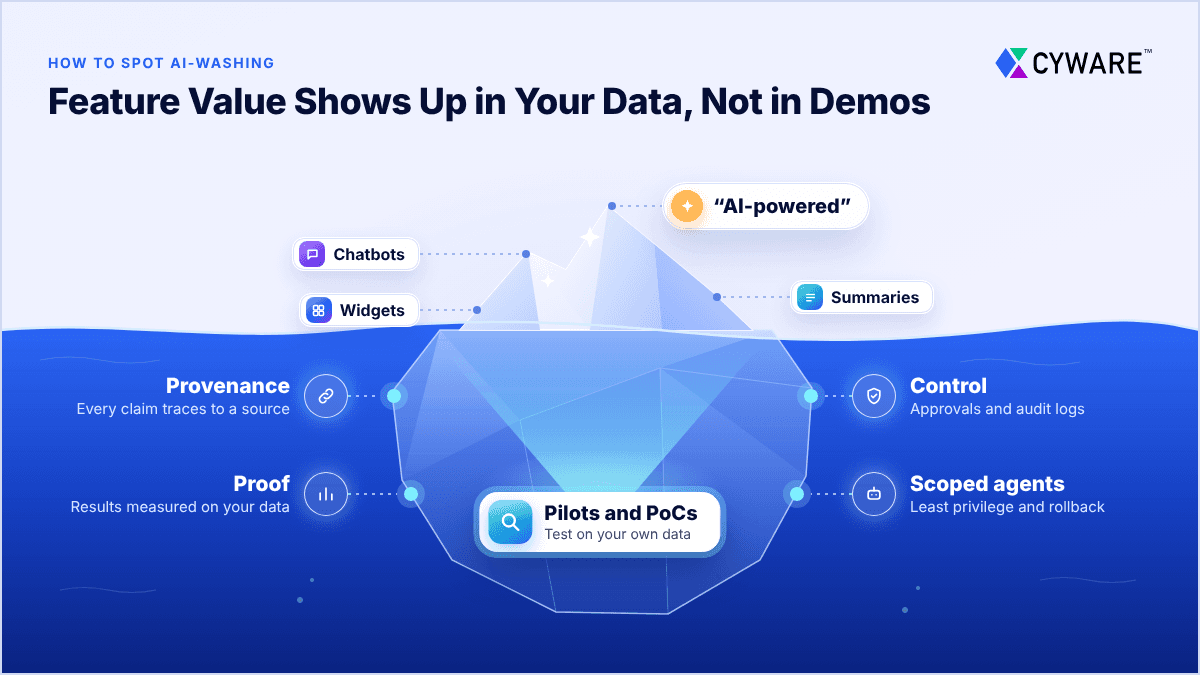
How to Spot AI-Washing
Regulators already penalize AI-washing, and the FTC's Operation AI Comply targeted deceptive AI claims in 2024. The SEC charged two investment advisers over false AI claims the same year. Buyers should test for it too.
Marketing decks all look the same, but the differences show up when you test on your own data. Watch for these warning signs in a proof of concept:
Read-only "AI." If the model cannot trigger platform actions through defined tools or APIs, it is assistive search. Test: ask it to take an action, not answer a question.
No provenance. Every extracted IOC and summary claim should trace back to its source and ingestion time. Test: click through three random claims in a summary.
Noisy extraction. Weak extractors mishandle defanged indicators like hxxp and [.]. They also flag benign references, such as public DNS resolvers, as malicious. Test: upload a real vendor report and inspect what lands as an IOC.
Black-box or one-way scores. If a two-year-old IP still scores 90, scoring is not risk-based. Scores should also learn from sightings and false positives in your tools. Test: ask for a score breakdown and per-type decay settings.
Attribution stated as fact. Actor links should carry confidence levels, evidence, and analyst sign-off before publishing.
Unscoped agents. Agents should run with least privilege, per-action approvals, and rollback. The OWASP Top 10 for Agentic Applications lists goal hijacking and tool misuse as top risks. Prompt injection already tops OWASP's LLM risk list. Test: ask how the platform handles a poisoned report.
Unvalidated detections. Generated rules should compile, carry ATT&CK tags, and pass tests on historical logs. Test: ask for the false-positive rate on 30 days of your data.
TLP as a label, not a control. TLP 2.0 markings, including TLP:AMBER+STRICT, should be enforced across sharing, export, and integrations.
Vague data handling or lock-in. Ask whether prompts and intel are retained, used for training, or sent to third parties. AI that exports only in a proprietary format, not STIX 2.1, traps your intel.
No measurable outcomes. Ask for pilot metrics: analyst hours per report, false-positive rate, and time from advisory to block.
Buyer's Checklist: How to Evaluate an AI Threat Intelligence Platform
Features are only half the evaluation. Score each vendor on four broader criteria as well:
Operational complexity: Count the sources, formats, tools, and teams the platform must serve. Many unstructured sources and several teams favor AI-powered extraction and routing.
Integration requirements: Map which tools must send and receive intel, and how quickly. Two-way exchange with SIEM, SOAR, and EDR calls for closed-loop automation.
Governance maturity: Check that policies exist for AI data use, human approvals, and audit. Without them, agentic workflows can add more risk than they remove.
Measurable business value: Confirm you can baseline cost, time, and outcomes today. The ROI section below lists the metrics to capture.
Use this list to compare vendors side by side. For a printable version, download the TIP Buyer's Checklist.
Area | What to check |
Ingestion | Extracts IOCs and TTPs from PDFs, web pages, and emails; deduplicates; keeps source links |
Enrichment and summaries | Automatic enrichment; summaries for each audience; every claim cited |
Natural-language query | Plain-English questions; grounded answers; admits when data is missing |
Scoring and lifecycle | Explainable, tunable scores; PIR-driven relevance; automatic aging |
Actor profiling | Actor links with confidence and evidence; alias merging; ATT&CK mapping |
Early warning | Leaked credentials, lookalike domains, dark web, exploit activity; matched to exposure |
Agentic workflows | Multi-step agents; approval gates by action and risk; full audit log |
Orchestration | Two-way integration with SIEM, SOAR, EDR, and firewalls; feedback improves scores |
Detection engineering | Sigma, YARA, or KQL rules; explanations; testing before deployment |
Sharing | Auto-redaction; TLP enforcement; two-way STIX/TAXII |
Governance | No training on your data; private model options; role-based approvals; AI can be turned off |
Deployment | Cloud, on-premises, or hybrid options for data residency |
Time to value | Realistic timeline to first use case; prebuilt integrations and playbooks |
ROI | Analyst time saved, false positives reduced, feed value, MTTD and MTTR |
How to Measure the ROI of AI in Threat Intelligence
AI features should prove their value with numbers, not demos. Many CTI programs lack the baseline to do that. The 2026 SANS CTI Survey found that 57% of programs do not track maturity over time.
The wider business case is easier to see. IBM's 2026 Cost of a Data Breach Report puts the global average breach cost at $4.99 million. Extensive users of security AI and automation saved $1.93 million on average versus non-users.
That figure covers security operations broadly, not TIPs alone. Your own baseline is the stronger proof. Capture these metrics before a pilot, then track them after rollout:
Analyst hours per report: Timestamp intake and approval of each intel package in the TIP.
Time from advisory to action: Compare advisory time with the first SIEM, EDR, or ticket action.
False-positive rate: Pull analyst dispositions on pushed indicators back from the SIEM and SOAR.
Intel-driven detections: Tag alerts, hunts, and blocks with the intel object that triggered them.
PIR coverage: Map new intelligence to each PIR and track the share covered each week.
Feed value: Join actioned, unique indicators per feed with each feed's license cost.
AI override rate: Log how often analysts correct extractions, scores, or summaries.
Track accuracy alongside speed. A falling override rate shows analysts trust the output for good reason.
Questions to Ask Vendors
Use these questions in demos and RFP reviews. Ask vendors to answer each one live, on your own data.
Area | Questions to ask |
Ingestion and enrichment | Can I drop in a PDF and see extracted IOCs and TTPs, each linked to its source? Can I add my own enrichment sources? |
Summaries and search | Can I click any line in a summary or answer and see the records behind it? Does the platform say when it lacks the data? |
Scoring and lifecycle | Can I see why one indicator ranked higher than another? Can I tune scoring to my PIRs and set aging rules by indicator type? |
Actor profiling | Does each actor link show a confidence level and evidence? Can I compare an actor's ATT&CK techniques with my detection coverage? |
Early warning | Can the platform match leaked credentials, lookalike domains, and exploit activity to my own assets? |
Agents and orchestration | Which actions need analyst approval, and can I set rules by action type? Does intel flow both ways with my SIEM, SOAR, and EDR? |
Detection engineering | Can I edit generated Sigma or YARA rules and test them on my data before deployment? |
Sharing | Does the platform redact sensitive data and enforce TLP labels before intel leaves my organization? |
Governance | Is my data used to train any model, and will you put that in the contract? Can I export a full audit log of AI actions? |
Conclusion: Choose AI That Gives Your Analysts Their Time Back
The right question is not "Does this platform have AI?" Every platform says yes. The better question is "Does this AI change how my team works, and can I trust it?"
The features in this guide build on each other. Clean ingestion makes enrichment accurate. Good enrichment makes scoring reliable. Reliable scoring makes automation safe. Sharing turns one team's work into a defense for many.
So test vendors on real data, and ask to see the reasoning behind every answer. Insist on human control over every action that matters.
The goal is not more intelligence. It is better decisions, made faster, by the people who know your business best.
See how Cyware Intel Exchange applies these AI capabilities across the threat intelligence lifecycle. Book a demo.
Frequently Asked Questions
What is an AI-powered threat intelligence platform?
An AI-powered threat intelligence platform (TIP) uses machine learning, generative AI, and agents to process threat data. Like any TIP, it collects, normalizes, deduplicates, enriches, and scores intelligence from many sources. It then shares relevant intelligence with security tools and teams.
Unlike a traditional TIP, it can read unstructured reports and answer plain-language questions. It can also run multi-step workflows, with humans approving high-impact actions. Learn more in what is a threat intelligence platform.
How is AI used in threat intelligence?
AI extracts indicators from unstructured reports and enriches them with context. It scores intel by relevance, summarizes long reports, and maps behavior to MITRE ATT&CK. AI agents can also triage alerts and draft detection rules, with analysts approving high-impact actions. See more AI threat intelligence use cases.
What are the four types of threat intelligence?
The four types are strategic, operational, tactical, and technical. Strategic intelligence informs leadership decisions about risk, budget, and priorities. Operational and tactical intelligence describe campaigns and adversary TTPs. Technical intelligence covers indicators such as IPs, domains, and hashes. AI helps most with technical and tactical work.
What are the 5 stages of the threat intelligence lifecycle?
The five stages are planning, collection, processing, analysis, and dissemination, with feedback closing the loop. AI helps most in collection, processing, and analysis. It also speeds dissemination by pushing intel to security tools. Humans still set requirements and make final judgments.
What is the difference between a TIP, a SIEM, and a SOAR?
A TIP collects and makes sense of external threat intelligence. A SIEM analyzes logs from your own environment to detect suspicious activity. A SOAR automates response workflows across security tools.
They work best together. The TIP feeds scored intel into the SIEM and SOAR. Those tools send sightings, outcomes, and false positives back to the TIP.
Do I need a TIP if I already have threat feeds and a SIEM?
Usually, yes. Feeds deliver raw data, and a SIEM can only use what it is given. Without a TIP, duplicates, stale indicators, and irrelevant intel flow straight into alerts.
A TIP filters, scores, and enriches intel first. Your SIEM gets fewer, better signals, and analysts waste less time.
Can you add AI to an existing threat intelligence platform?
Yes, in most cases. Many TIP vendors now ship AI features as upgrades, including extraction, summaries, and natural-language search. Teams can also connect an existing platform to AI tools through its API.
The limits come from the platform underneath. AI works best on clean, STIX-structured data with clear provenance. Agentic workflows also need two-way integrations and approval controls that older platforms may lack.
Can AI replace threat intelligence analysts?
No. AI removes repetitive work like collecting, sorting, and summarizing, but analysts still make the judgment calls. Deciding what a threat means for your business needs human expertise.
Confirming attribution and approving response actions do too. The best platforms make analysts faster and more focused, not unnecessary.
What is the best AI threat intelligence platform?
It depends on your use case, team size, and existing tools. Gartner published its first Magic Quadrant for Cyberthreat Intelligence Technologies in May 2026, evaluating 17 vendors.
Commercial options with embedded AI include Cyware Intel Exchange, Anomali ThreatStream, and ThreatConnect. ThreatConnect is now part of Dataminr. Recorded Future and Google Threat Intelligence pair large intelligence datasets with generative AI. For open source, OpenCTI offers AI features in its enterprise edition.
Test each one on extraction accuracy, explainable scoring, and AI governance using your own data. See our comparison of top threat intelligence platforms.
Is there a free or open-source AI threat intelligence platform?
Yes, MISP and OpenCTI are the best-known open-source TIPs, and both can connect to AI tools. They are free to license but need in-house skills to deploy, integrate, and maintain.
Commercial TIPs add built-in AI, prebuilt integrations, and support. See the best open-source threat intelligence platforms.
Is agentic AI safe to use in threat intelligence?
It can be, with guardrails. The OWASP Top 10 for Agentic Applications lists risks such as goal hijacking and tool misuse. The CrowdStrike 2026 Global Threat Report saw attackers inject malicious prompts into GenAI tools at over 90 organizations.
Look for least-privilege agents, approval gates for high-impact actions, and full audit logs.
About the Author