
242
Threat Intelligence Requirements to evaluate vendors
18
Capability Domains to compare threat intelligence vendors
.xlsx
Ready-to-use Excel spreadsheet delivered to your inbox
How to use this Template
Go from defining your threat intelligence requirements to evaluating vendors with a structured, evidence-based approach.
- 01
Set your priorities
Walk the priority column with your team and decide what is Must, Should, and Nice for your environment before anything reaches a vendor.
- 02
Send it to the shortlist
Every vendor answers the same 242 rows in the same four columns: compliance, written response, evidence type, and reference document.
- 03
Score side by side
Compare completed sheets column by column. Gaps, hedges, and roadmap promises surface instead of getting lost in a deck.
Success criteria, 18 capability areas
The template evaluates a platform across 18 areas. Expand any area to see what it covers, how many requirements it carries, and how many of those are mandatory.
Platform Architecture & Scalability
Whether the platform holds up at your data volume, in your jurisdiction, and under your availability requirements.
1.1Multi-Tenancy & Tenant Isolation
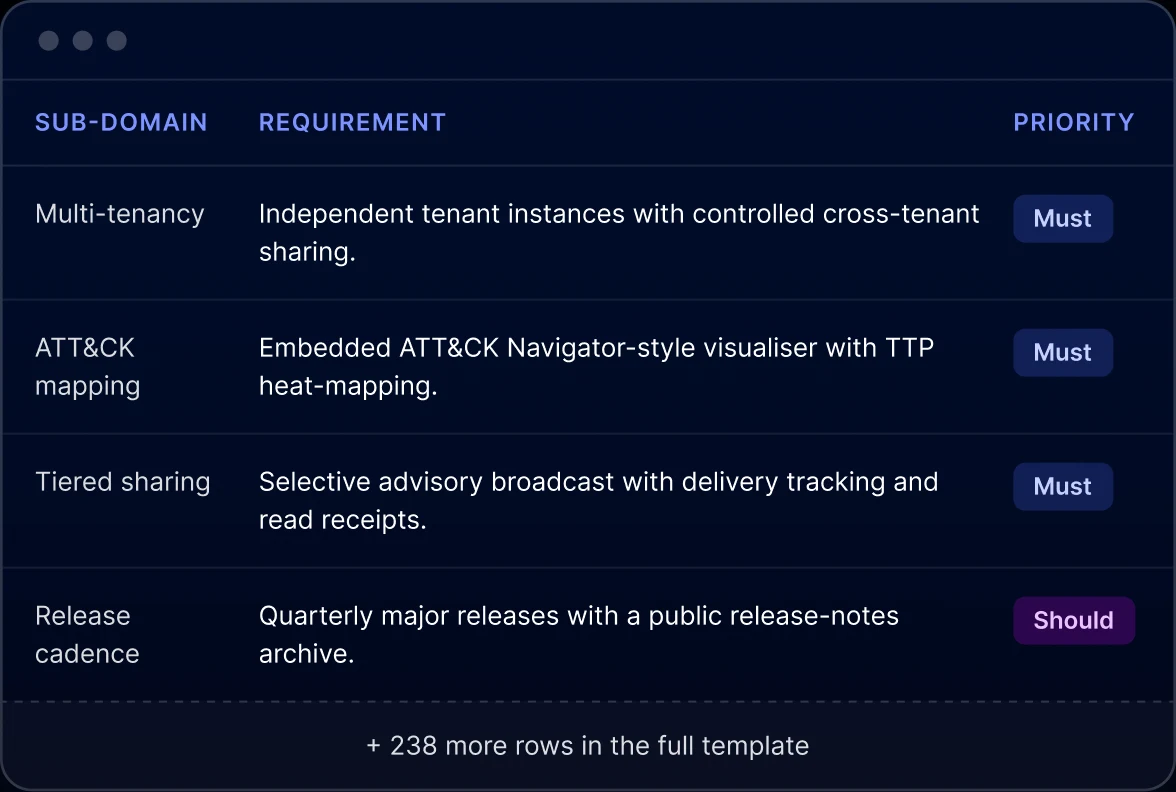
The solution must support a multi-tenant architecture in which multiple consuming organisations or business units can operate independent tenant instances, while still enabling controlled threat-intelligence sharing between tenant instances where permitted by data-sharing policy.
Logical tenant isolation must be enforced at the application, data-store, and audit-log layers. Tenant configuration, ingested intelligence, users, audit logs, and analyst outputs must not be visible or accessible across tenant boundaries under any condition.
The solution must offer a single-tenant deployment option for customers with regulatory or sensitivity constraints that preclude shared-tenancy operation.
1.2Scalability & Growth
The solution must be architected to scale horizontally to accommodate a growing user base, an expanding set of integrated data sources, and increasing intelligence volume — without requiring customer-initiated capacity-planning exercises, re-architecture, or scheduled re-sizing windows.
The solution must scale ingestion, enrichment, processing, search, and dissemination capacity transparently as workload increases, and surface platform-utilisation telemetry so administrators can validate scaling behaviour.
The solution must support a documented minimum of concurrent analyst users and a documented API throughput ceiling appropriate to the proposed deployment scale. Vendor must publish API-throughput benchmarks alongside the conditions under which they were measured.
1.3Deployment Models
The solution must be available as a SaaS offering hosted on a Tier-1 hyperscale cloud provider (AWS, Microsoft Azure, or Google Cloud), with documented multi-region availability.
The solution must additionally be available as an on-premises or single-tenant private-cloud deployment option for jurisdictions or workloads with sovereign data-residency, regulatory, or air-gapped operating requirements. Vendor must enumerate any feature delta between SaaS and on-prem deployment modes.
The solution must support a hybrid deployment topology in which a SaaS instance interoperates with a lightweight on-premises integrator / gateway component, enabling the platform to reach into on-premises security tools without requiring inbound network exposure of the customer environment.
1.4Data Residency & Sovereignty
Bidder must confirm the available SaaS hosting regions and allow the Issuing Authority to nominate a primary hosting region. Tenant data — including ingested intelligence, reports, investigations, and audit logs — must not leave the nominated region without explicit customer consent.
Where the solution performs processing using third-party AI / ML / language-model providers, vendor must disclose the providers used, the regions in which inference is executed, and the contractual data-handling guarantees (in particular, prohibition of training on tenant data and zero retention beyond the inference call).
1.5High Availability & Disaster Recovery
The solution must commit to a minimum monthly platform availability for core functions, supported by a documented Service Level Agreement, service credits for breach.
The solution must support Disaster Recovery with a documented Recovery Point Objective and Recovery Time Objective appropriate to enterprise / public-sector operational expectations. Vendor must describe the underlying multi-AZ / multi-region architecture.
1.6API & Programmatic Access
The solution must expose a documented RESTful API supporting full programmatic access — data retrieval, data sharing, and CRUD operations (Create, Read, Update, Delete) across every major platform object type.
The API must support OAuth 2.0 and/or scoped API-token authentication, expose a published OpenAPI / Swagger specification, support versioning, and notify users programmatically when API rate limits are being approached or exceeded.
The solution should expose its query and dissemination capabilities through standards-based programmatic interfaces consumable by external automation clients and AI assistants (e.g., MCP or equivalent). Where applicable, vendor to describe the supported interface(s).
1.7Data Lineage & Traceability
The solution must maintain data lineage and chain of custody on every ingested intelligence object — analysts must be able to view a historical timeline of who has viewed, modified, enriched, or tagged a specific piece of data over time.
Lineage information must be exposed in both the user interface and through the API, and must persist across enrichment, normalization, deduplication, and analyst-driven edits.
1.8Network & Connectivity
The solution must offer IP allow-listing for inbound administrative access, and outbound connector egress from a stable, documented set of source IP ranges that the Issuing Authority can permit through its perimeter controls.
1.9Browser & Endpoint Support
The web application must be supported on current versions of Microsoft Edge, Google Chrome, Mozilla Firefox, and Apple Safari without requiring proprietary client-side plugins, browser extensions, or legacy runtimes (excepting any optional analyst browser-extension utilities offered by the bidder).
1.10Container & Orchestration
For on-premises and private-cloud deployments, the solution must be packaged using container technology and must support deployment automation via standard configuration-management or orchestration tooling.
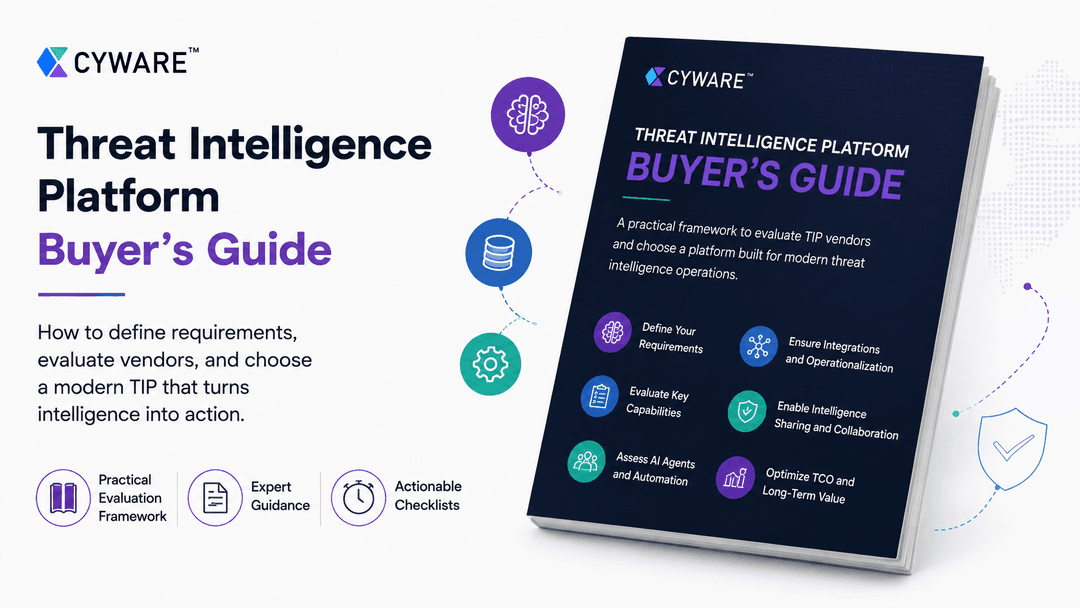
Get the Editable RFP Template
One ready-to-use spreadsheet across 18 capability areas.
- 242 requirements across 18 capability areas, each with a unique ID
- Built-in vendor response fields for compliance, explanations, evidence, and references
- Must, Should, and Nice priorities to align your team before vendor evaluation
- Live completion tracker to monitor vendor responses across capability areas
Compliance — the vendor answers
- Yes
- Generally available, native to the platform, and running in production for a comparable customer.
- Partial
- Available with limits, extra configuration, an add-on, or a third party. The limitation must be described.
- No
- Not available and not on the committed roadmap within 18 months.
Priority — you set
- Must
- Mandatory for award. A No here can disqualify a bidder.
- Should
- Important and weighted in scoring, but not disqualifying.
- Nice
- A differentiator that counts as upside.
125 of the 242 rows ship tagged Must. Adjust them to your environment before the RFP goes out.