


PIR for Enterprises: Stop Writing Requirements Nobody Monitors

CTO and Co-Founder Cyware
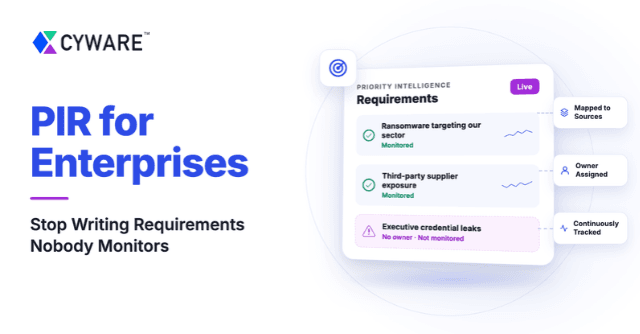
Key takeaways
Relevance is the first filter. A PIR is your organization's definition of what relevant means, and everything else follows from it.
Written PIRs aren't enough. A requirement has to be connected to the intelligence that flows in every day.
Enterprise PIRs need a quality check before they go live, matching on meaning across finished and raw intelligence, and a health measure for every requirement.
Silence is a signal. A PIR that goes quiet often points to a gap in your sources, not an absent threat.
There is a question every CISO eventually asks their threat intelligence team: "What are we actually monitoring, and are we covered?" It sounds simple. In most organizations, it is surprisingly hard to answer. Not because the team isn't working hard, and not because there isn't enough intelligence. If anything, there is too much. The problem is that the requirements meant to focus all that intelligence usually live somewhere the intelligence never touches.
Priority Intelligence Requirements should be the answer to that question. In practice, they rarely are. This piece is about why that happens, what it takes to fix it at enterprise scale, and the choices we made when we built the PIR Agent in Cyware Intel Exchange. And it starts with one word.
Relevance is the job, not a feature
If I had to reduce threat intelligence to one idea, it would be relevance. Not volume, not speed, and not accuracy on its own. Intelligence that doesn't apply to your organization doesn't help you, however good it is.
Teams don't have an intelligence shortage. They have a relevance problem. Every day, analysts make the same judgment over and over: does this matter to us? Who are we, what do we run, who do we depend on, and who has gone after organizations like ours? That judgment is the most valuable thing a CTI team does, and it is also the thing that gets repeated from scratch every morning.
PIRs are how you make that judgment once and apply it continuously. They are the written definition of what relevant means for your organization. That's why I think of them less as a planning artifact and more as the relevance engine of the entire intelligence program.
A PIR is your organization's definition of relevance, written down.
The uncomfortable truth about PIRs
Most enterprise teams have written PIRs. They are in the annual intelligence plan, a wiki page, or a set of saved searches someone set up two reorganizations ago. And that is exactly where they stay.
A PIR that lives in a document has three problems. It doesn't change what an analyst looks at when they start their day. It can't tell you whether it is being answered. And it doesn't notice when the world moves on.
That last one matters more than people think. Threats shift, businesses reorganize, and priorities move. A requirement that was exactly right in January can be quietly wrong by June. The way I put it to teams is simple: if your PIRs never change, you're defending against the plan you wrote, not the adversary in front of you.
Why it gets harder at enterprise scale
In a small team, one analyst can hold every priority in their head. In an enterprise, that stops working quickly, for three reasons.
More voices - Good PIRs need input from well beyond the intelligence team: the CISO, SOC and vulnerability management leads, fraud and third-party risk owners, and the business units that run critical systems. Every one of those stakeholders has a different idea of what "important" means.
More requirements - Programs grow to dozens of PIRs, and each one can match thousands of records a day. Nobody can re-run that many searches by hand and keep up.
More accountability - Boards and auditors want a defensible answer about coverage. "We think we're covered" is not a defensible answer.
The discipline behind PIRs is right. The manual practice is what breaks.
What we set out to build
When we designed the PIR Agent, we went back to where this piece started: relevance is the first filter. A perfectly accurate, perfectly timely report on a threat that has nothing to do with you still costs your analyst time to read and dismiss. Everything in the product follows from taking that seriously. Four principles shaped it.
1. Start with intent, not syntax
Analysts shouldn't need to learn a query language to say what they care about. In the PIR Agent, you write the requirement in plain English, and the agent extracts what it refers to: threat actors, MITRE ATT&CK-mapped techniques, sectors, geographies, and asset types.
But plain language cuts both ways. "Track all threat actors" is easy to write and useless to monitor. So before a PIR goes live, the agent scores the intent on four measures: scope clarity, threat focus, specificity, and atomicity. It tells you what is weak and offers a stronger version you can accept, edit, or ignore. We wanted the quality check to happen at the moment it is cheapest to fix, which is before anything is matched.
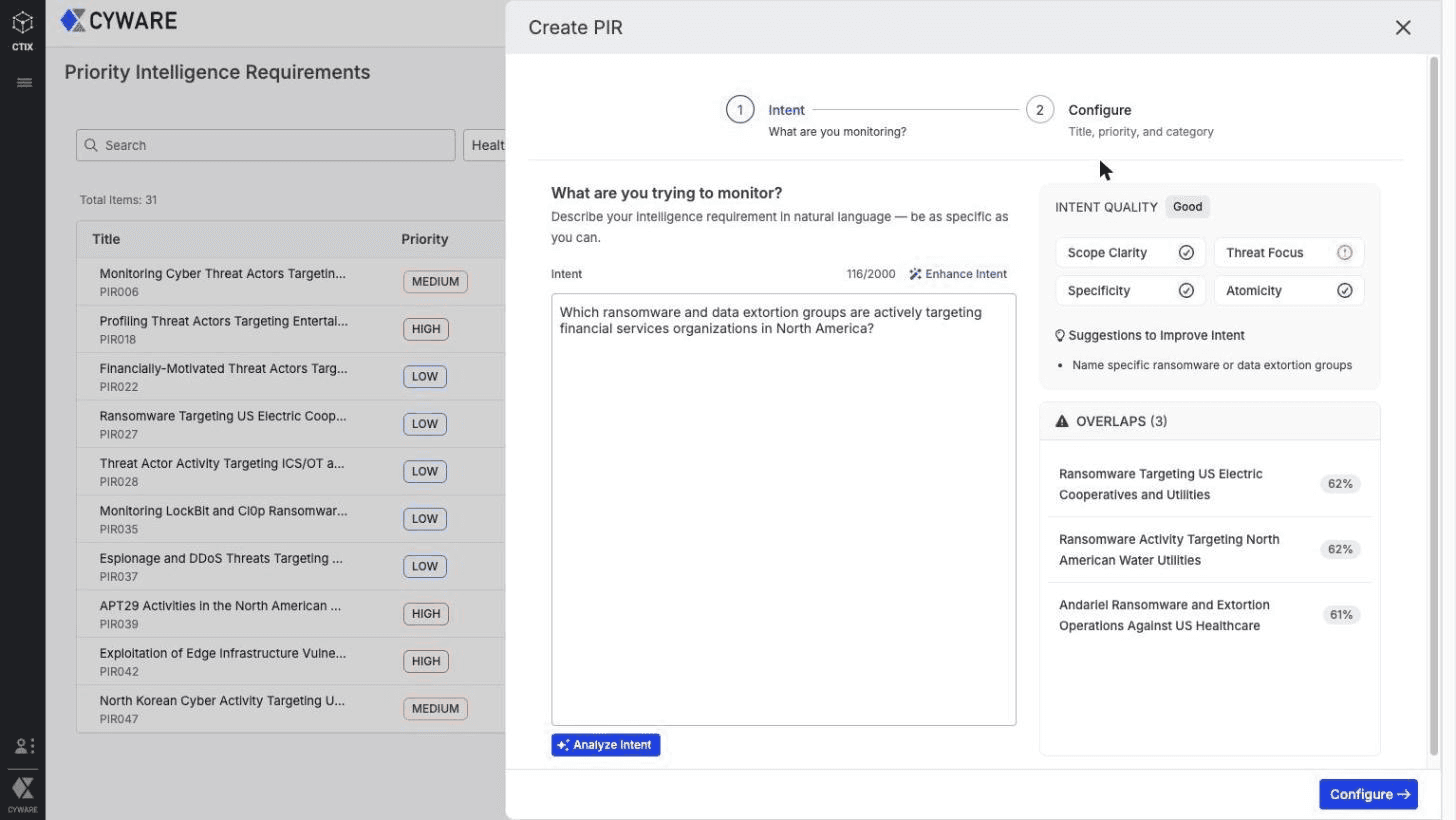
The agent scores the intent and suggests how to strengthen it before the PIR goes live.
It also checks every new requirement against the ones you already have and flags similar PIRs with a similarity score. PIR sprawl is real. Without that check, teams end up with five slightly different ransomware requirements, all competing for the same analyst's attention.
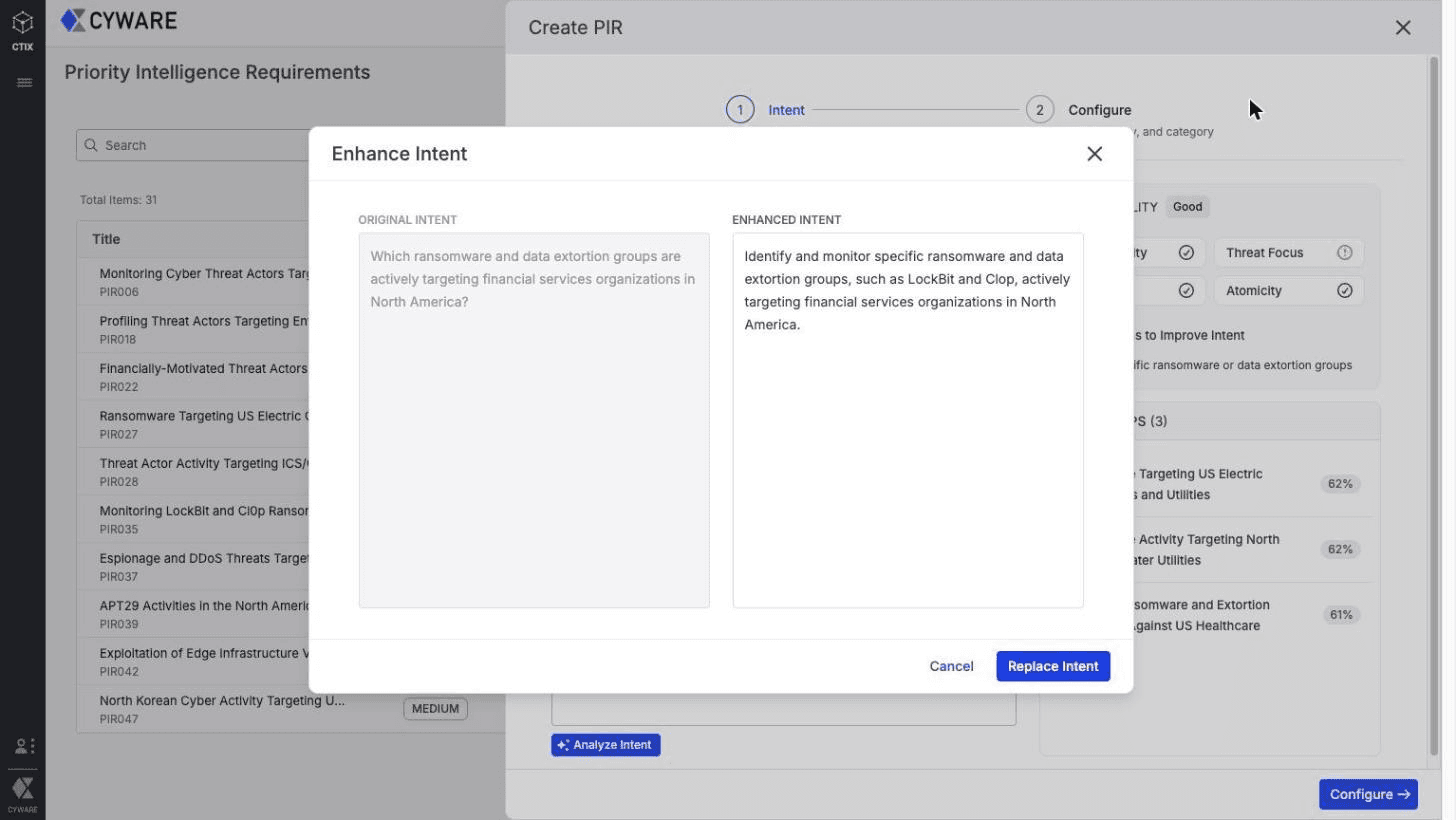
Enhance Intent shows the original and the suggested rewrite side by side, and the analyst decides.
2. Match on meaning, across everything that comes in
Keyword matching fails quietly. The same campaign gets described a dozen different ways by a dozen different sources, and a saved search catches only a fraction of them.
The PIR Agent matches on meaning, using semantic similarity for actors, campaigns, malware, reports, techniques, vulnerabilities, advisories, and alerts, and precise matching for IOCs. Just as important, it works across finished intelligence and raw intelligence that nobody has structured yet: threat bulletins, RSS feeds, social feeds, the threat mailbox. Emerging activity often surfaces in the messy channels before it reaches finished reporting, so that is where matching needs to work.
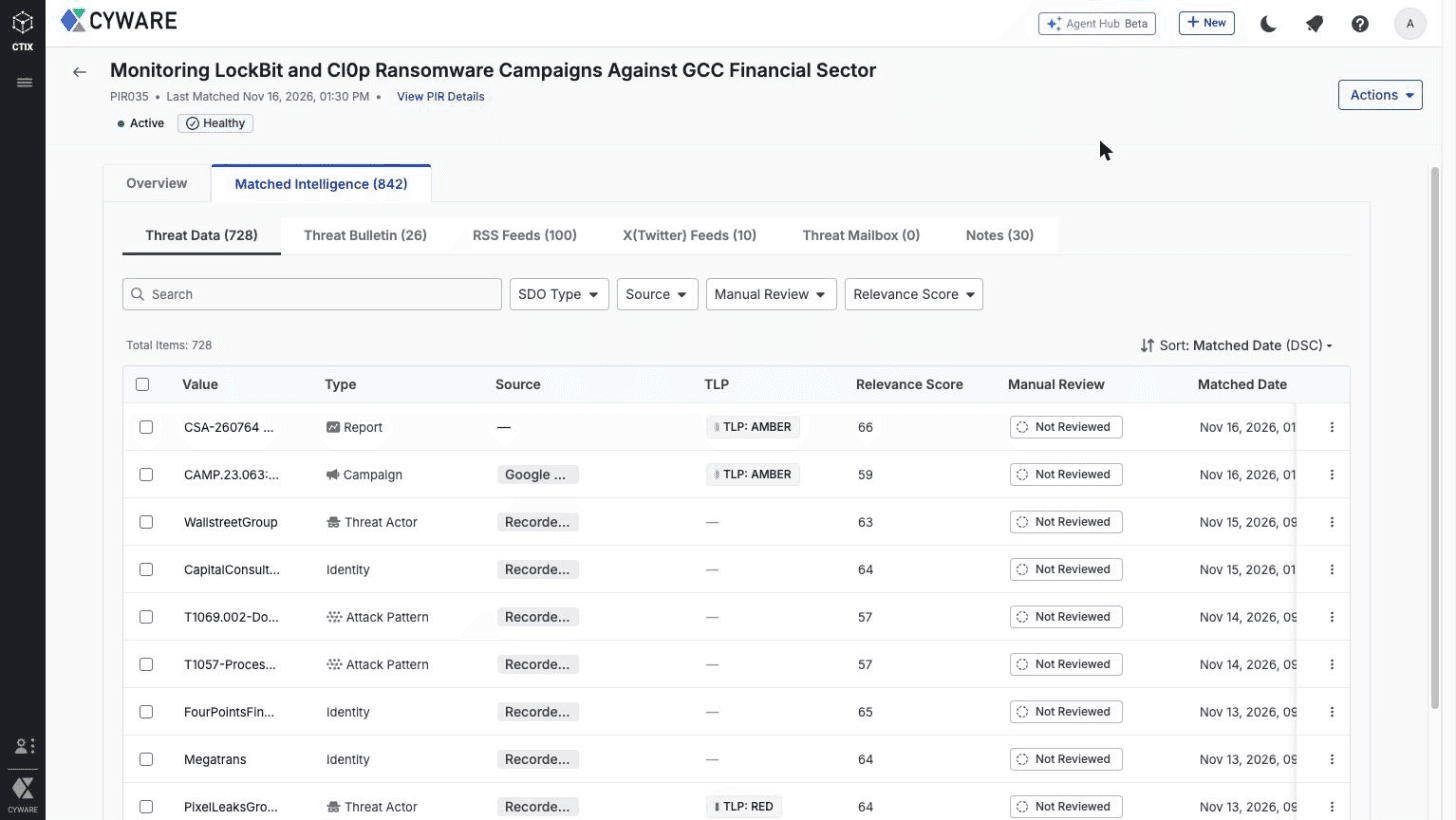
Every match carries its source, TLP, and an AI relevance score, across ingestion channels.
3. Treat every requirement as something you can measure
This is the principle I care about most. A PIR should be able to tell you how it is doing.
Every PIR in Cyware carries a composite health score built from coverage, freshness, confidence, and velocity. It is rated healthy, degrading, or unhealthy, and the agent raises signals when something meaningful changes: a new actor attributed to activity you track, a spike in activity, a rising risk, or a requirement that has gone quiet.
That last signal is my favorite, because it changes how teams think. When a PIR stops receiving intelligence, the instinct is to assume the threat went away. Often, it didn't. The product flags it as a likely coverage gap, not an absent threat. Silence is data. It often means your sources aren't looking where your priorities are.
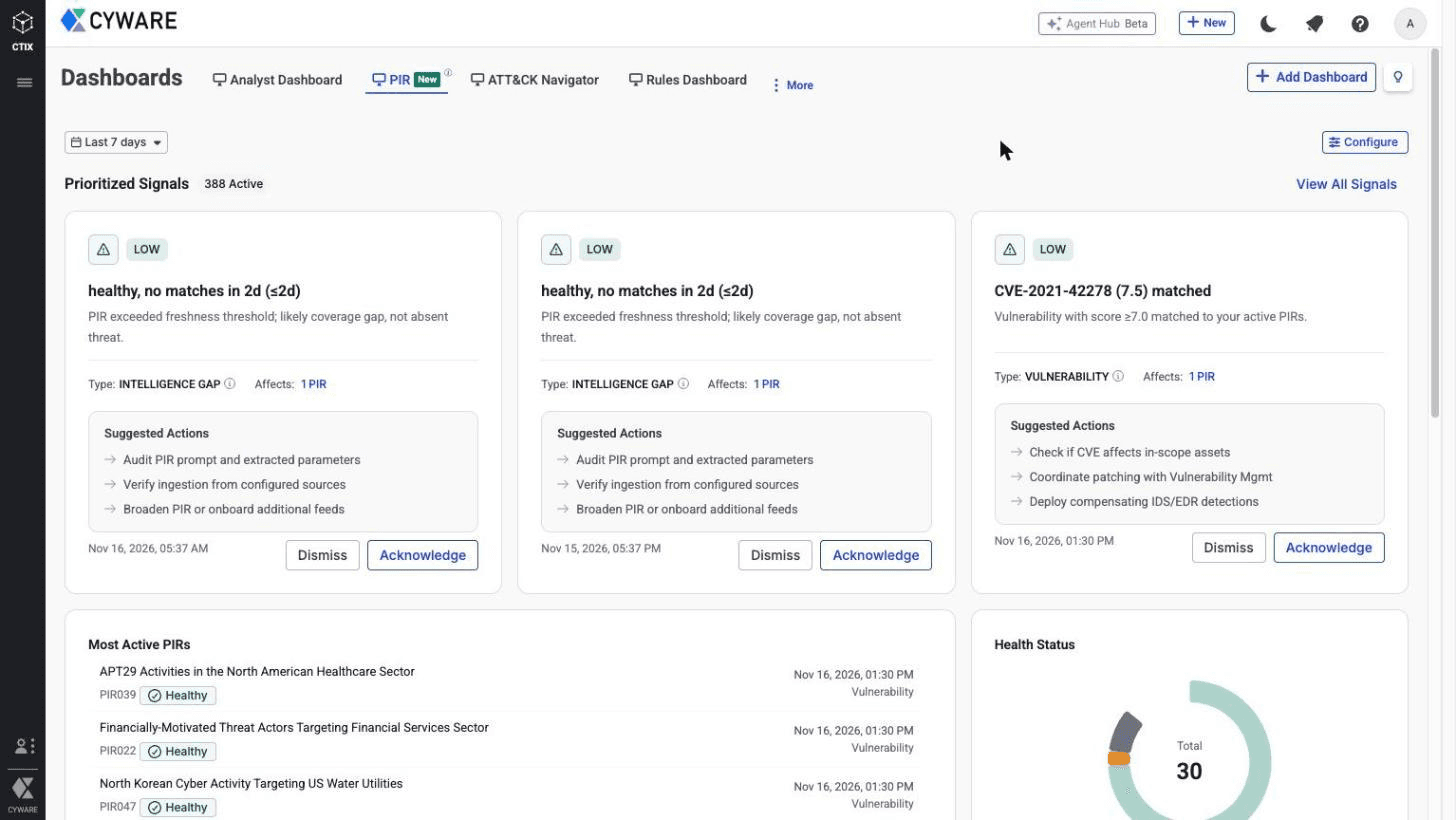
The PIR dashboard surfaces prioritized signals across every requirement, including intelligence gaps.
4. Keep the analyst in charge, and keep the record intact
AI should make analysts faster. It shouldn't make decisions behind their backs. In the PIR Agent, analysts can mark matches as reviewed, tell the agent whether a match was relevant, or unlink it entirely, and those decisions stick. A false positive you remove today doesn't come back tomorrow, and your feedback improves what gets matched next.
Every PIR is also backed by a hash-chained, append-only audit trail. When leadership asks what you were monitoring and when, you have an answer that holds up.
What changes for leadership
For a CISO, the value of an operational PIR program isn't another dashboard. It is a different kind of conversation. Instead of "we think we're covered," a CTI lead can walk in each quarter and say: here are the requirements we track, here is which ones are healthy, here are the ones that went quiet and what we did about it, and here is what we retired because the business moved on.
That is the real shift. Intelligence stops being a stream the security team consumes and becomes a set of commitments it can report on, with the evidence and the audit trail to back each one up.
If you are starting tomorrow
You don't need a new platform to start running PIRs better. Here is what I would tell any team:
Start with decisions, not data. Ask your stakeholders what they decide, and what they wish they had known earlier. Write PIRs for those decisions first.
One requirement, one monitoring need. If a PIR asks three things, it is three PIRs.
Give every PIR an owner and an expiry date. Requirements without owners never get reviewed, and requirements without end dates never get retired.
Treat silence as a finding. A quiet PIR is a question about your sources, not a reason to relax.
Review when the world changes, not just when the calendar says so. A geopolitical escalation or an attack on a peer is a reason to revisit your requirements that week.
Where this goes next
Relevance only pays off when it leads to a decision or an action. Because Cyware Intel Operations is native to the Cyware Intelligence Suite, the context a PIR builds can flow into playbooks without an export and import gap.
The longer arc is simple to describe: requirements that tell you what to look for, measure whether you are finding it, and help you act on what you find. We are building toward that one deliberate step at a time, and PIRs are where it starts.
Back to that question
"What are we monitoring, and are we covered?" Every security leader deserves a clear answer to that, backed by evidence rather than instinct. Written PIRs can't give you that answer. Operational ones can.
Get the PIR Operationalization Playbook for the full framework, templates, example PIRs, and a maturity checklist.
See the PIR Agent for yourself. Book a demo or connect with one of our AI experts.
About the Author
Akshat Jain
CTO and Co-Founder Cyware