


AI vs. Traditional Threat Intelligence Platforms: Key Differences and When to Upgrade

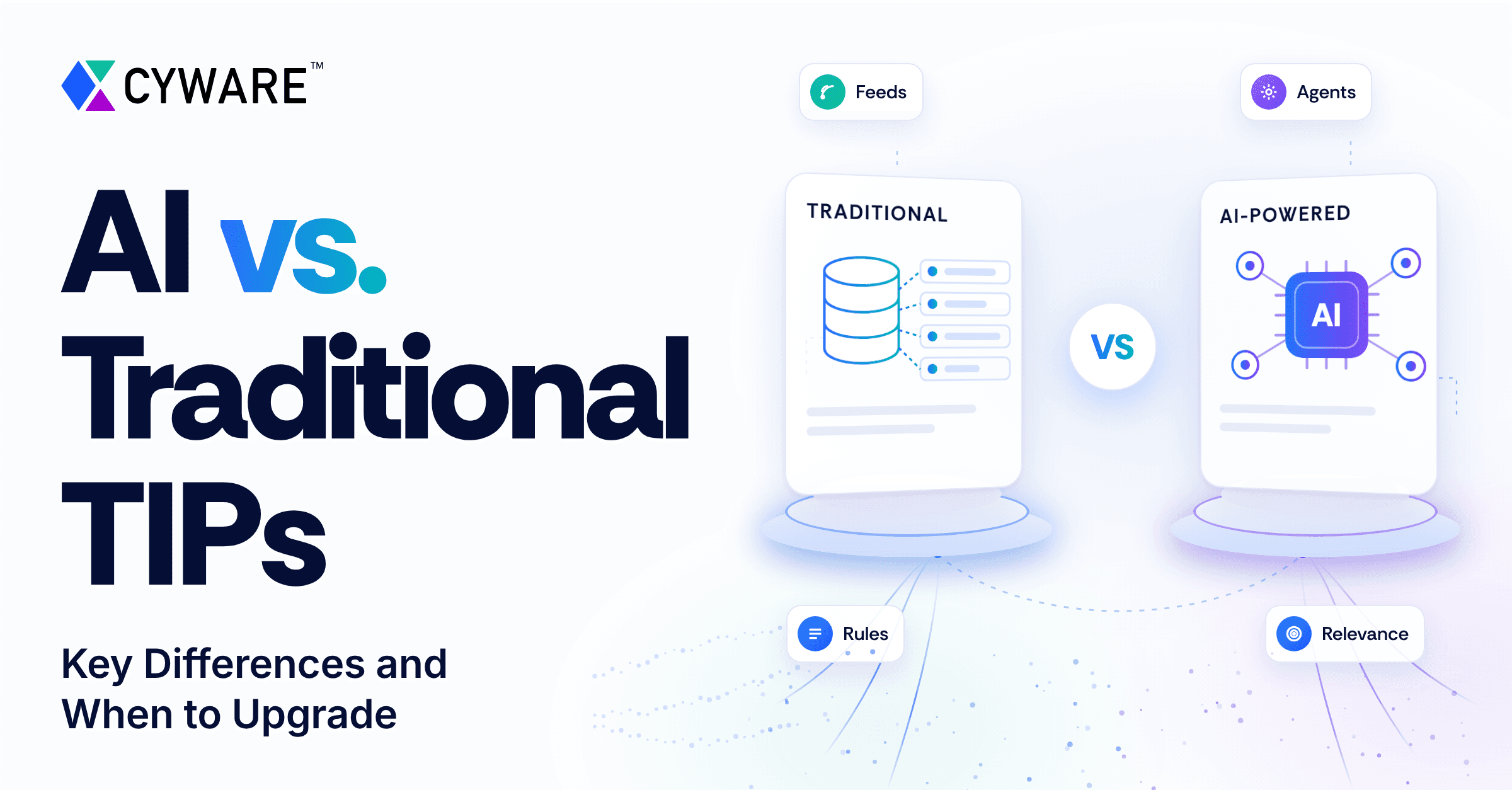
It is 4:55 p.m. on a Friday when a new CISA advisory lands. It lists 60 indicators, three CVEs, and a set of attacker techniques. Two teams receive it. One runs a traditional threat intelligence platform, and the other runs an AI-powered one.
Both platforms ingest the advisory and push indicators to security tools automatically. The difference starts after that. The first team sees 60 indicators with vendor severity and must work out what matters. The second team sees which indicators match its assets, ranked against its PIRs. It reviews a recommended response within the hour.
The difference is not the data. It is who does the work.
That gap is now the main buying question in threat intelligence. The 2026 SANS Cyber Threat Intelligence Survey found that 91% of CISOs value threat intelligence. Only 26% say it drives their decisions. Lack of time is a top barrier for 44% of respondents. Gartner's April 2026 research describes a shift from feeds to AI agents.
Short answer: A traditional TIP automates collection and sharing, but analysts must still interpret the data. An AI-powered TIP reasons over that data in context. It answers questions in plain language and runs agent-driven workflows, from threat briefings to vulnerability watch. Humans review the output and approve high-impact actions.
This guide compares both side by side and explains when it makes sense to upgrade.
AI vs. Traditional TIP: Quick Comparison
Area | Traditional TIP | AI-powered TIP |
Collection | Structured feeds at scale; unstructured reports need analyst extraction | Any format, with actors, TTPs, and relationships extracted |
Prioritization | Auditable rules for source, confidence, and type | Relevance scoring tied to your PIRs, assets, and industry |
Analysis | Indicators at scale, with manual links to actors | Suggested actor, campaign, and ATT&CK links with confidence |
Investigation | Filters, query syntax, and graph pivots | Plain-language questions with cited answers |
Action | Integrations and rule-based playbooks | Agents that adapt to new advisories, with approval gates |
Feedback | Partial, with sightings reviewed by hand | Closed loop that adjusts scores automatically |
Analyst role | Reading, triage, and correlation | Review, judgment, and decisions |
New risks | Stale data and noise, with predictable behavior | Also hallucinations, prompt injection, and agent permissions |
The table simplifies things, since most real platforms sit somewhere between the two columns. The rest of this guide explains each difference and what it means for your team.
What Is a Traditional Threat Intelligence Platform?
A traditional threat intelligence platform (TIP) is a single pane of glass for threat data. It aggregates feeds, normalizes indicators, and stores them in one place. It then shares them with security tools and partners, often through STIX and TAXII.
Traditional TIPs still do important work well:
Aggregating many commercial, open source, and community feeds
Deduplicating structured indicators and keeping their sources
Scoring indicators with rules that teams can read and audit
Sharing intelligence with ISACs, peers, and subsidiaries
For many teams, this foundation still matters, and AI builds on top of it rather than replacing it.
Where Traditional TIPs Fall Short
The limits of traditional TIPs show up as volume grows. Most of them come down to one problem: the platform stores intelligence, but people must do the thinking.
Unstructured intel needs manual work. Many valuable reports arrive as PDFs, blogs, and emails. Pattern matching catches some IOCs, but analysts still extract actors, TTPs, and context by hand.
Static scores miss context. Rule-based scores rarely reflect your assets, industry, or Priority Intelligence Requirements (PIRs). A high score does not always mean a relevant threat.
Indicators expire fast. Attackers rotate IPs and domains quickly. Platforms built around indicators struggle to track the behavior behind them.
Intelligence flows one way. Many TIPs push indicators to tools but learn little from the results. In the same SANS survey, 49% of respondents gather no systematic feedback on CTI effectiveness.
None of these are failures of the people running the platform. They are limits of a design built for an earlier volume of data.
What Is an AI-Powered Threat Intelligence Platform?
An AI-powered threat intelligence platform uses machine learning, generative AI, and AI agents across the threat intelligence lifecycle. It keeps the TIP's core jobs, then automates much of the reading, scoring, and routing.
Gartner's Feeds to Agents research separates two kinds of AI:
Assistive AI summarizes, answers questions, and suggests next steps. Analysts still take every action.
Agentic AI plans and carries out multi-step tasks. It works within approval rules that humans set.
The Gartner research predicts a firm deadline. By 2029, vendors without embedded agentic AI will be displaced from security shortlists. That prediction is why "AI TIP vs. traditional TIP" has become a live question for buyers.
8 Key Differences Between AI and Traditional TIPs
1. Collection: Structured Feeds vs. Any Format
Traditional: The platform aggregates commercial, open source, and ISAC feeds in STIX, CSV, and JSON. It normalizes and deduplicates indicators and keeps each one tied to its source. Some platforms parse IOCs from text using pattern matching. Analysts still extract actors, TTPs, and context by hand.
AI-powered: The platform reads reports, web pages, and emails the way an analyst would. Language models extract indicators, CVEs, malware, actors, and TTPs, plus the relationships between them. Results are normalized to STIX 2.1, with each object linked to its source. Analysts review the extraction instead of building it.
For lean teams, this difference alone can return hours every week. The SANS survey found that most formal CTI teams have fewer than four full-time staff.
2. Prioritization: Static Rules vs. Relevance
Traditional: Teams build auditable scoring rules around source reliability, confidence, and indicator type. Aging rules expire old indicators on a set schedule. The rules rarely reflect your assets or PIRs. A critical score may still describe a threat that never touches your stack.
AI-powered: Scores still use source reliability and confidence, then add context that fixed rules cannot see. Models weigh corroboration across sources, recency, and fit with your assets and industry. The best platforms tie scoring to your PIRs, so relevance has a clear definition. Each score shows the factors behind it.
This is the heart of the Relevance Doctrine: the problem is rarely too little data. It is too little relevance.
3. Analysis: Indicators vs. Behavior
Traditional: The platform manages indicators of compromise (IOCs), such as IPs, hashes, and domains, at scale. Enrichment integrations add reputation, WHOIS, and sandbox data. Analysts can link indicators to actors and campaigns, but they build those links by hand.
AI-powered: The platform suggests links from new indicators to known actors, campaigns, and techniques. Each link carries a confidence level. It maps behavior to MITRE ATT&CK, which documents 182 named threat groups. Analysts confirm or reject each link. Behavior changes far more slowly than indicators, so defenses built on it last longer.
4. Investigation: Query Syntax vs. Plain Language
Traditional: Analysts search with filters, query syntax, and graph views that show how indicators connect. These tools are precise and auditable. Each pivot is manual, so experienced analysts get far more from them than newer ones.
AI-powered: Analysts can ask questions in plain English, alongside the same filters and graph views. For example: "Which actors targeting healthcare used this CVE in the last 90 days?" Good platforms answer from their own data and cite every record they use. Newer analysts reach the same depth as power users.
5. Action: Fixed Playbooks vs. Governed Agents
Traditional: The platform pushes vetted indicators to SIEMs, firewalls, and EDR through built-in integrations. Rule-based playbooks automate repeatable steps, such as blocking high-confidence IOCs. Playbooks follow fixed logic, so analysts still decide how to handle each new type of advisory.
AI-powered: Agents handle the cases that fixed logic cannot anticipate. They check a new advisory against your environment, build a timeline, and draft a response. They push vetted intel to your SIEM, SOAR, and EDR, then pull results back. Playbooks still run the repeatable steps, and agents decide which ones apply.
Low-risk steps can run on their own. Actions that change your environment, such as blocking an IP, should wait for analyst approval. CISA and NSA's 2026 guide, Careful Adoption of Agentic AI Services, recommends the same checkpoints.
6. Feedback: Manual Review vs. Closed Loop
Traditional: The platform shares indicators with your SIEM, firewall, and partners over STIX/TAXII. Some integrations return sightings, and analysts can mark false positives by hand. Those results rarely change scores automatically. The platform learns little about which feeds catch real attacks.
AI-powered: Sightings, detections, and false positives flow back from your tools without manual tagging. Each result adjusts the score of the indicator and the source that supplied it. Feeds that keep producing noise lose weight, and feeds that catch real activity gain it.
This loop is what lets a team measure its intelligence program. Without it, teams cannot prove which intel stopped an attack. They also cannot tell which feeds earn their cost.
7. The Analyst's Role: Triage vs. Judgment
Traditional: The platform removes much of the manual aggregation and sharing work. Analysts still read reports, triage indicators, and connect context themselves. Judgment work, such as assessing business impact, often waits until that queue is clear.
AI-powered: AI takes over the reading, extraction, and first-pass triage. Analysts review AI output, confirm attribution, and decide what a threat means for the business. The team does not shrink, but its time moves to the judgment work that waited before.
The 2026 SANS CTI Survey found that 45% of organizations already use AI in CTI. Most use it for summarization and report writing, and keep humans in the loop.
8. New Risks: Stale Data vs. Hallucinations and Agent Misuse
Traditional: The main risks are stale indicators and noisy feeds. Both waste analyst time and can trigger false positives. In return, its behavior is predictable. Every score and action traces back to a rule a person wrote.
AI-powered: Those risks remain, and AI adds new ones. Generative answers can sound confident and still be inaccurate. Agents with broad permissions can take actions nobody approved. Mature platforms counter this with cited answers, scoped permissions, and full audit logs.
Prompt injection is the risk most specific to threat intelligence. An AI TIP reads untrusted content by design, including reports, forums, and attacker-controlled pages. Instructions hidden in that content can steer what the model says or does.
What AI Does Not Change
AI changes how fast intelligence moves, not what makes intelligence good. Four fundamentals still apply:
Requirements come first. Without PIRs, AI simply processes more noise, faster.
Source quality still matters. AI cannot make a weak feed reliable. It can only help you measure which feeds earn their cost.
Humans own judgment. Attribution, business impact, and high-impact actions still need an analyst's decision.
AI adds new risks. Generative answers can be wrong, and agents can be manipulated. The OWASP Top 10 for Agentic Applications lists goal hijacking and tool misuse as top risks.
Governance closes that gap. Look for cited answers, least-privilege agents, approval gates, and full audit logs. The NIST AI 600-1 generative AI profile is a useful checklist for those conversations.
AI TIP vs. Traditional TIP: Which Do You Need?
The right choice depends on your volume, team size, and how far intelligence must travel. A traditional TIP can still be enough in some cases. Beyond volume and team size four criteria show whether your program is ready for AI and whether it will pay off:
Operational complexity: Count the sources, formats, tools, and teams your program serves. A few structured feeds serving one SOC suit a traditional TIP. Many unstructured sources serving several teams, business units, or members favor AI-powered extraction and routing.
Integration requirements: Map which tools must send and receive intelligence, and how quickly. One-way delivery to a SIEM or firewall works well on a traditional TIP. Two-way exchange with SIEM, SOAR, EDR, and ticketing at machine speed calls for closed-loop automation.
Governance maturity: Check whether policies exist for AI data use, human approvals, and audit. Approval gates, role-based access, and audit logs are prerequisites for agentic workflows. Without them, the risk of AI actions can outweigh the time saved.
Measurable business value: Confirm you can baseline cost, time, and outcomes today. If metrics show the team keeps pace with intake, the upgrade case is weak. If analyst time limits response speed or PIR coverage, AI has a measurable gap to close.
Governance maturity deserves extra weight. An AI-powered TIP without approval rules can add more risk than it removes. If policies are not ready, start with assistive features while governance catches up. The NIST AI Risk Management Framework offers a practical structure for that work.
You do not always need to rip and replace. Many teams start by adding AI features to their current workflow, then expand as trust grows.
Measuring the ROI of an AI-Powered TIP
An AI-powered TIP should prove its value with numbers, not demos. Many CTI programs lack the baseline to do that. The 2026 SANS CTI Survey found that 57% of programs do not track maturity over time. Almost half (49%) do not systematically gather feedback on effectiveness.
That gap shows up at budget time. SANS notes that programs unable to show improvement struggle to defend their budgets with data.
The wider business case is easier to see. IBM's 2026 Cost of a Data Breach Report puts the global average breach cost at $4.99 million. Extensive users of security AI and automation saved $1.93 million on average versus non-users.
That figure covers security operations broadly, not TIPs alone. Your own baseline is the stronger proof. Capture these metrics before rollout, then track them through the pilot and after cutover:
Metric | What it measures | How to capture it |
Analyst hours per report | Time from receiving a report to a reviewed intel package | Timestamp intake and approval in the TIP |
Time from advisory to action | Hours between an advisory and the first block, hunt, or detection | Compare advisory time with SIEM, EDR, or ticket timestamps |
False-positive rate | Share of pushed indicators that analysts mark as noise | Pull analyst dispositions back from the SIEM and SOAR |
Intel-driven detections | Alerts, hunts, and blocks traced to TIP intelligence | Tag alerts and tickets with the source intel object |
PIR coverage | Share of PIRs that received relevant intelligence each week | Map new intelligence to each PIR in the platform |
Feed value | Actioned, unique indicators per feed, compared with its cost | Join sightings data with feed license costs |
AI override rate | How often analysts correct extractions, scores, or summaries | Log analyst edits and rejected agent actions |
Each metric maps to work analysts already do. If AI extraction works, analyst hours per report fall. If relevance scoring works, false positives drop and intel-driven detections rise. Report the hours saved and where the team reinvested them, such as hunts or briefings.
Track AI accuracy alongside speed. A falling override rate shows analysts trust the output for good reason. A rising rate is an early warning that a model, prompt, or source needs review.
How to Move From a Traditional TIP to an AI-Powered One
Enterprise platform migrations rarely start with the new technology. They start with an honest audit of the current platform and the contract behind it. Most teams then move in phases and run both platforms side by side before cutover.
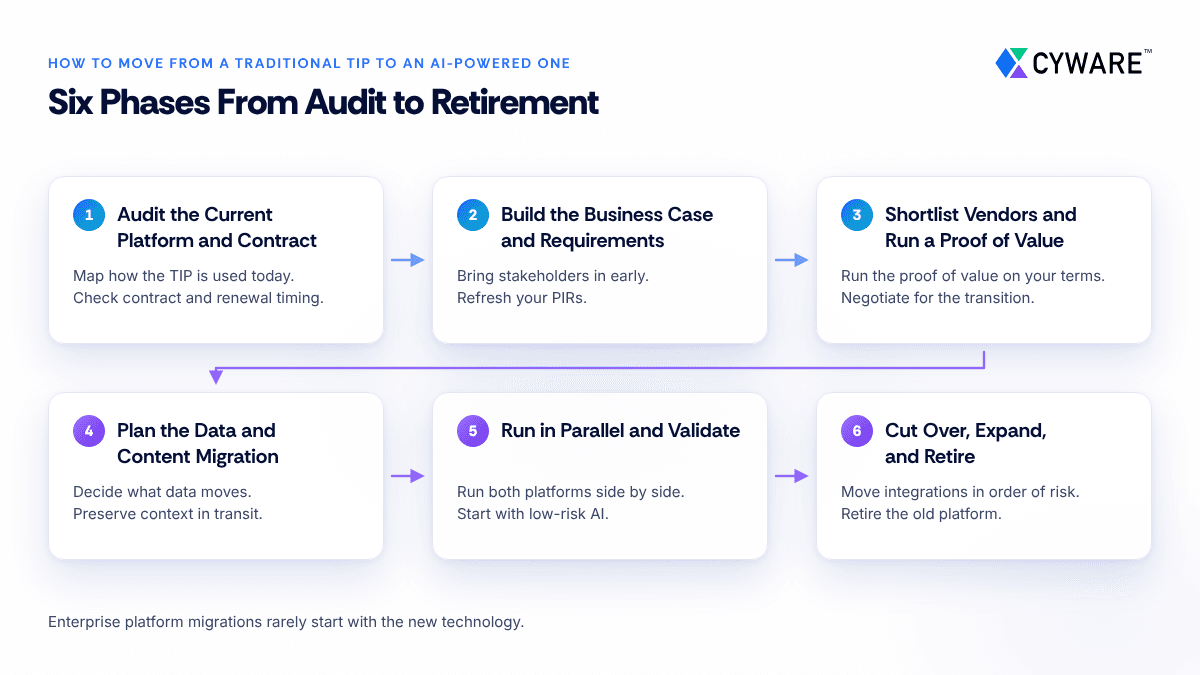
Phase 1: Audit the Current Platform and Contract
Map how the TIP is used today. List every feed, integration, playbook, scoring rule, sharing community, and custom field. Note which teams consume its intelligence and how often.
Score the incumbent honestly. Rate the current platform against today's needs, not the needs it was bought for. The gaps become your requirements list and your business case.
Check contract and renewal timing. Note the license end date, notice period, and data export rights. Feed subscriptions tied to the old platform need the same review.
Capture a baseline. Record the metrics from the ROI section above before anything changes. Without a baseline, no one can prove the migration paid off.
Phase 2: Build the Business Case and Requirements
Bring stakeholders in early. Involve the SOC, incident response, vulnerability management, procurement, legal, and privacy teams. Each has requirements and approvals that surface late if ignored.
Refresh your PIRs. Confirm the questions intelligence must answer for each stakeholder, then rank them. They become the scoring logic and acceptance tests for the new platform.
Write functional and operational requirements. Rank use cases by business risk, then add needs for deployment, data residency, single sign-on, and scale.
Set an AI policy before you shop. Decide which data may reach external models and which actions need human approval. The NIST AI Risk Management Framework gives these decisions a structure.
Phase 3: Shortlist Vendors and Run a Proof of Value
Narrow the field. Use an RFI or a TIP Buyer's Checklist to cut the list to three to five vendors.
Run the proof of value on your terms. Give every vendor the same scripted scenarios, your own reports, and your own feeds. Score extraction accuracy, relevance, and analyst effort against the incumbent.
Test integrations in both directions. Confirm connectors for every tool on your inventory, plus TAXII 2.1 and TLP 2.0 support. Check that sightings and false positives flow back, not only out.
Review AI and agent controls. Ask where prompts and intel are processed and whether they train any model. Confirm per-action approvals, least-privilege permissions, and complete audit logs. CISA and NSA's Careful Adoption of Agentic AI Services guide sets a useful bar.
Complete the security and vendor risk review. Assess the vendor's security practices, certifications, and data handling before signing. CISA's Secure by Demand Guide lists questions to ask software vendors.
Negotiate for the transition. Secure an overlap period, data export terms, and migration support in the contract. Paying for both platforms briefly costs less than a rushed cutover.
Phase 4: Plan the Data and Content Migration
Decide what data moves. Migrate active, high-confidence indicators, actor profiles, finished reports, and sighting history. Archive expired indicators instead of importing years of noise.
Preserve context in transit. Export in STIX 2.1 where possible, so confidence, TLP markings, and source references survive the move. Map custom fields and tags before the first import.
Rebuild content, do not copy it. Carry over only the scoring rules and playbooks tied to current PIRs. Treat legacy logic as input to the new design.
Sequence the work. Assign owners and dates for each feed, integration, and sharing partner. Use the vendor's professional services for the first integrations.
Phase 5: Run in Parallel and Validate
Run both platforms side by side. Send the same sources to the old and new platforms. Compare extraction quality, scores, and false-positive rates on identical data.
Start with low-risk AI. Turn on extraction, deduplication, and summaries first. These save time without changing your environment.
Tune scoring and close the feedback loop. Test scoring changes on historical data. Pull sightings and false positives from your SIEM and EDR into the new platform.
Train analysts and update runbooks. Show analysts how to review AI output and when to override it. Update escalation and approval runbooks to match.
Phase 6: Cut Over, Expand, and Retire
Move integrations in order of risk. Switch read-only connections first, then blocking and response tools. Keep a rollback path for each one.
Repoint sharing partners. Give ISACs and partners the new TAXII endpoints and confirm that collections sync. Retire old endpoints only after both sides confirm.
Get sign-off, then add agents. Obtain written sign-off from security, IT operations, and compliance owners. Then let agents run low-risk steps alone, widening autonomy only while accuracy holds.
Retire the old platform. Export and archive its data under your retention policy. Revoke its accounts and API keys, then end the license.
Intel Exchange · Cyware AI Agents: Agents for PIRs, threat briefings, and vulnerability watch build on existing intel workflows. Analysts review drafts before anything is shared or actioned.
For vendor comparisons, we have compiled a list to assess the top threat intelligence platforms in 2026.
Conclusion: Upgrade the Work, Not Just the Platform
Traditional TIPs gave security teams a place to collect and share threat data. AI-powered TIPs change who does the work inside that place.
The right question is not "Does this platform have AI?" It is "How much analyst time does it return, and can we trust what it does?"
Start with your PIRs, automate the reading work, and add agents only with clear approval rules. The goal is not more intelligence. It is faster, better decisions by the people who know your business best.
See how Cyware Intel Exchange brings AI to the full threat intelligence lifecycle. Talk to a threat intelligence expert.
Frequently Asked Questions
What is a threat intelligence platform?
A threat intelligence platform (TIP) collects threat data from many sources, then normalizes, enriches, and scores it. It shares relevant intelligence with security tools and teams. AI-powered TIPs automate much of that work.
Will AI replace traditional threat intelligence platforms?
AI is changing TIPs more than replacing them. Core jobs like aggregation, storage, and sharing remain. AI adds extraction, relevance scoring, and agents on top. Gartner expects vendors without embedded agentic AI to leave shortlists by 2029.
Can you add AI to an existing TIP?
Yes, in most cases. Many TIP vendors now ship AI features as upgrades, including extraction, summaries, and natural-language search. Teams can also connect an existing platform to AI tools through its API.
The limits come from the platform underneath. AI works best on clean, STIX-structured data with clear provenance. Agentic workflows also need two-way integrations and approval controls that older platforms may lack. If those are missing, a phased migration may cost less than retrofitting.
What is agentic threat intelligence?
Agentic threat intelligence uses AI agents that plan and carry out multi-step CTI tasks. Examples include triaging advisories, checking indicators in your environment, and drafting detections. Humans set the rules and approve high-impact actions.
What is the difference between an IOC and an IOA?
An indicator of compromise (IOC) is an observable artifact associated with potentially malicious activity. Examples include a suspicious IP address, domain, file hash, or registry key. NIST defines IOCs as technical artifacts suggesting an attack is imminent, underway, or has already occurred.
An indicator of attack (IOA) describes behavior that suggests an attack is being attempted or is underway. Examples include credential dumping from system memory or a script launching encoded PowerShell commands.
Attackers can swap an IP or hash easily, but changing their techniques takes far more effort. AI-powered TIPs can correlate both with MITRE ATT&CK techniques, such as OS Credential Dumping (T1003). That adds the context analysts need to prioritize a response.
What are the limitations of AI in threat intelligence?
AI can produce confident answers but isn’t always accurate, and agents can be manipulated through poisoned inputs. It also cannot fix weak requirements or poor sources. Grounded answers, approval gates, and audit logs reduce these risks however.
What are the best AI-powered TIPs?
It depends on your use case, team size, and existing tools. Gartner published its first Magic Quadrant for Cyberthreat Intelligence Technologies in May 2026, evaluating 17 vendors.
Commercial options with embedded AI include Cyware Intel Exchange, Anomali ThreatStream, and ThreatConnect. ThreatConnect is now part of Dataminr. Recorded Future and Google Threat Intelligence pair large intelligence datasets with generative AI. For open source, OpenCTI offers AI features in its enterprise edition.
Test each one on extraction accuracy, explainable scoring, and AI governance using your own data.
About the Author