


How Cyware and Armis Are Solving the Context Gap Between Threat and Asset Intelligence

CTO and Co-Founder Cyware
TL;DR
The core problem: Threat intelligence tells security teams what is happening in the world. Asset intelligence tells them what exists in their environment. The difficult engineering problem is continuously connecting the two.
Armis provides real-time asset, device, and exposure context. Cyware correlates that context with global and organization-specific threat intelligence and orchestrates response.
Together, they connect threat indicators to the assets they may actually impact, including unmanaged and dynamically changing devices.
Agentic AI helps correlate evidence, assess confidence, and recommend or trigger response based on defined governance thresholds.
The result is asset-centric threat intelligence that reduces noise, improves prioritization, and accelerates response.
At a Glance
A threat indicator can be completely accurate and still be irrelevant to your environment. A malicious IP can be real. A CVE can be actively exploited. A ransomware group can be targeting your industry. But that still doesn't tell a security team whether any of it matters to them right now.
Security teams already have plenty of threat intelligence. Commercial feeds, OSINT, dark web monitoring, ISAC bulletins, vendor advisories, and internal telemetry generate a steady stream of information every day. The harder question is what to pay attention to.
A critical CVE tells you that a vulnerability is serious. A threat report tells you that an adversary is active. An IOC tells you that an IP, domain, or hash has been linked to malicious activity. But none of that, by itself, tells you which assets in your environment are actually exposed, how accessible they are, or what the impact could be if they were compromised.
That is where context matters. Security teams need to connect what they know about threats with what they know about their own environment.
It sounds simple. In practice, it is not.
Threat intelligence and asset data are built around different identifiers, change at different speeds, and are often maintained across different systems. Bringing them together accurately and keeping that connection current is the real challenge.
That is the problem Cyware and Armis from ServiceNow are working to solve by bringing threat intelligence and real-time asset intelligence together.
Why Can't Security Teams Tell If a Threat Actually Matters to Them?
Threat intelligence describes the adversary and the threat. Asset intelligence describes the environment the adversary could affect. To determine whether a threat is relevant, defenders need an accurate, current picture of what they actually run:
Which devices exist
Which are internet-facing
Which are unmanaged or agentless
Which are safety-critical OT assets
Which have compensating controls
Which are exposed without adequate segmentation
The problem is that this picture is never static.
Asset inventories drift as devices move, addresses change, new systems appear, and shadow IT expands. Threat intelligence moves at the speed of the internet, while asset visibility often moves at the speed of the last audit.
Closing that gap requires more than better inventory. It requires continuously connecting threat intelligence to the assets it can actually affect.
Why Is Mapping Threat Intelligence to Your Asset Inventory So Hard?
The hard problem isn't collecting either dataset. It's joining them accurately.
Threat intelligence and asset intelligence speak different identity languages. Threat intelligence is keyed to IPs, domains, hashes, campaigns, and adversaries. Asset inventories are keyed to device IDs, MAC addresses, serial numbers, ownership, location, and business context. The mapping between those identities is also constantly changing.
On a managed endpoint running an agent, the translation is mostly solved: the agent reports its own IP and MAC together, so the two identifiers join easily. The harder case is everything else. Unmanaged and agentless devices, IoT sensors, OT controllers, BYOD laptops, don't run an agent to report that mapping, and their IP addresses shift with DHCP leases, VPN sessions, or a reboot.
Here, the correlation has to run in the other direction: Armis passively inspects the traffic each device actually generates, and Cyware checks those observed connections against known indicators, IPs, domains, or hashes tied to threat actors the organization already tracks, or IOCs surfacing in a live campaign against its sector. That correlation is only as good as the device identity behind it. If the IP-to-device mapping has drifted since the asset inventory last refreshed, the match can land on the wrong device entirely.
Reconciling those two identity spaces, continuously and at the scale of tens of thousands of devices, is the real engineering problem sitting underneath the phrase "asset-centric threat intelligence." It's also why passive, continuous discovery beats periodic scans here: a snapshot inventory is already stale by the time a match needs to be made, and a stale mapping doesn't just create noise, it can point an automated response at the wrong device. Most vendors say intelligence should be mapped to your environment. Far fewer explain why that mapping is genuinely hard, or what it takes to keep it accurate as addresses shift underneath you.
Why Doesn't More Detection Coverage Reduce Alert Fatigue?
That same identity gap doesn't just complicate threat correlation. It's a large part of why alert fatigue keeps getting worse, even as individual detection tools keep improving.
The volume problem isn't that any single tool has gotten noisier. Most detection platforms have invested heavily in enrichment and tuning specifically to cut down on low-value alerts. The real driver is proliferation: security teams now run detection across cloud, endpoint, network, identity, and SIEM layers, often five or six different tools, each doing its own job competently, each generating its own stream of alerts. No single tool is the problem. The aggregate across all of them is.
An identical finding can also mean radically different things depending on the asset behind it. An internet-facing HMI on a production floor carrying a given alert is not the same risk as an isolated test server carrying the identical one.
The signal becomes meaningful once it's evaluated against the asset it affects, and that's the same identity-resolution work described above, applied at the point of triage rather than at the point of correlation. Better prioritization, not more detection coverage, is what turns that volume into something an analyst can actually act on.
Vulnerability Management Has the Same Problem, at Greater Scale
Vulnerability management has its own version of the same problem, at even greater scale. Over 48,000 new CVEs were published in 2025 alone, a record high and a roughly 20 percent jump over 2024, according to independent CVE-tracking research from Jerry Gamblin's 2025 CVE Data Review, against a backdrop of finite patching windows, change-control cycles, and OT environments where patching itself can be operationally risky. No team can remediate everything with equal urgency, so prioritization is not optional: it's the entire job.
CVSS alone was never designed to carry that weight. A severity score describes theoretical impact in the abstract. It says nothing about whether a vulnerability is being actively exploited, whether the asset is reachable, or whether it sits on a system that would actually cause damage if compromised. That's why exploit-prediction models like EPSS, and known-exploited-vulnerability lists like CISA's KEV catalog, have become standard companions to CVSS. They add a badly needed layer of “is this actually happening” on top of “how bad could this be.”
CVSS tells you how severe a vulnerability could be. EPSS estimates the likelihood of exploitation. KEV tells you whether exploitation is already occurring in the wild.
But none of them tells you whether the vulnerable asset is exposed in your environment, how reachable it is, or whether compromising it would materially affect the business.
Even that combination is incomplete without asset and threat context together. EPSS and KEV say which vulnerabilities the world is exploiting in general, not which of your own assets carry them, whether those assets are exposed, or whether the exploitation is actually happening to organizations like yours. That second layer, threat context curated specifically for the organization rather than raw global feed noise, is what Cyware Intel Exchange is built to produce: narrowing worldwide intelligence down to the actors, campaigns, and indicators relevant to this org's sector and history. The strongest prioritization blends all three: severity, org-specific exploitation likelihood, and asset exposure. That full picture, asset context plus curated threat context, is the one most programs still assemble manually, if at all.
Why Doesn't a Correctly Prioritized Threat Automatically Trigger a Response?
Even after a finding clears every filter described above, the asset is exposed, the CVE is actively exploited, a threat actor known to target our sector is behind it, that still doesn't guarantee anything happens next. Plenty of organizations already have threat intelligence functions capable of producing exactly that kind of prioritized, asset-specific finding. It still often ends up as:
A dashboard entry
A weekly PDF
A well-written analyst report that circulates by email and gets acknowledged in a steering committee meeting
All of that has value, but none of it blocks an indicator, isolates a device, or opens an investigation on its own. The reason is structural: intelligence and operations live in different tools, owned by different teams, with different definitions of “done.” A CTI analyst's job often ends at publication; a SOC analyst's begins only once something lands as a ticket. That handoff is where good intelligence quietly stalls.
Operationalization, the discipline of turning intelligence into action, specifically detections, block lists, and orchestrated response, is what closes that gap. It's a workflow problem as much as an analytical one, the missing layer between “we know about a threat” and “we did something about it.”
Bringing Ground Truth to Threat Intelligence
For threat intelligence to drive an operational decision, three types of context need to converge:
Threat context: What are adversaries doing? Which indicators, campaigns, vulnerabilities, and techniques are relevant?
Asset context: What exists in the environment? Which assets are exposed, critical, unmanaged, or vulnerable?
Operational context: What telemetry, controls, and response actions are available?
The value comes from connecting these continuously rather than treating them as separate security functions.
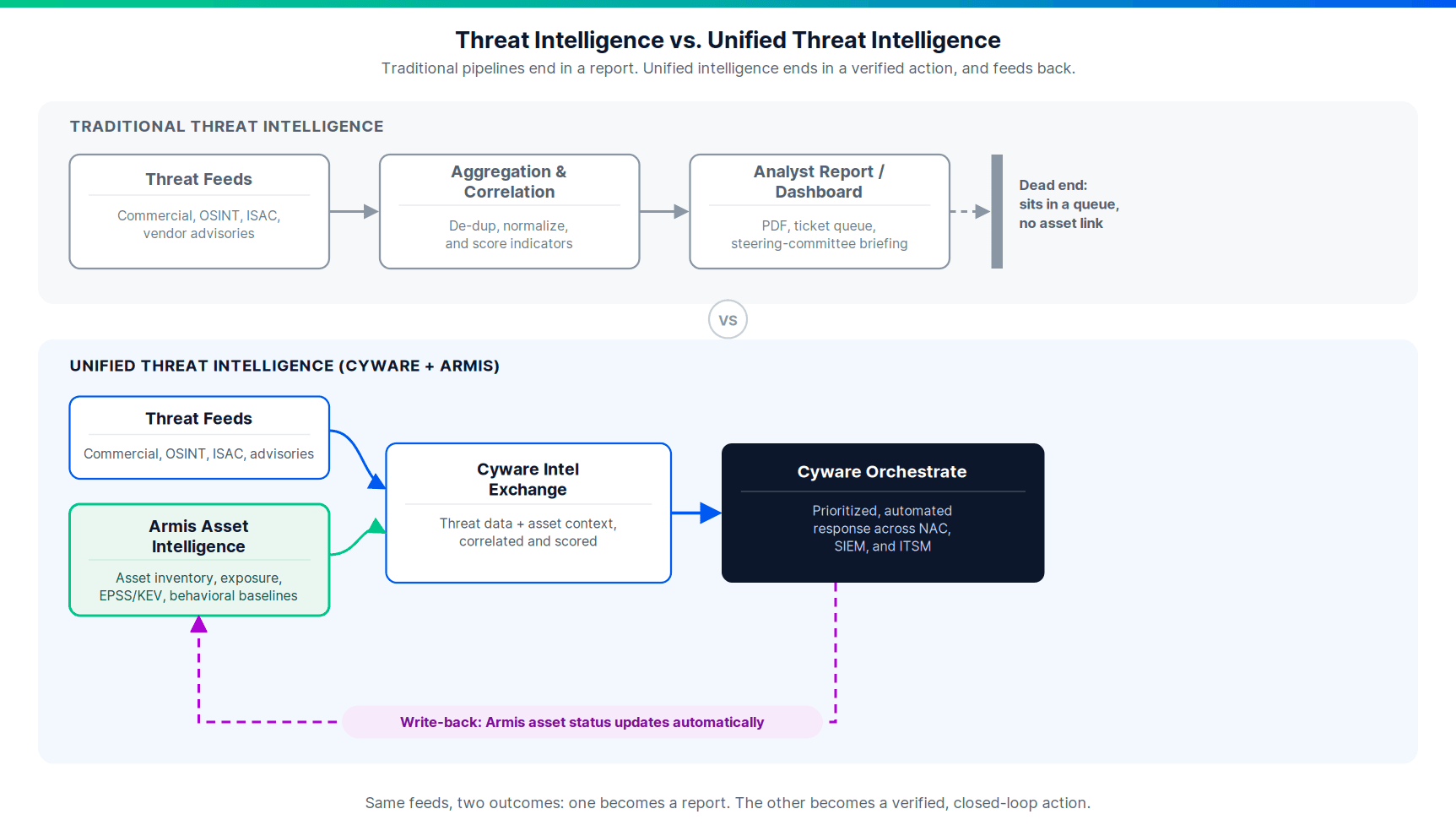
This is the problem the Cyware and Armis integration is designed to solve.
Armis provides continuously updated asset and exposure intelligence. Cyware provides threat intelligence contextualization and orchestration.
The integration connects these two views so that a threat indicator is not evaluated in isolation. It can be evaluated against the actual asset, exposure, business context, and available response actions associated with it.
Cyware, provides the threat intelligence and operational layer through its Cyware Intelligence Suite: ingesting, correlating, enriching, prioritizing, and orchestrating action across the security stack.
Armis provides the asset and exposure layer through its Armis Centrix: continuously identifying devices and their risk across IT, OT, IoT, and IoMT, including assets traditional agents may not see.
Together, the two systems connect threat context with asset context and operational response.
Two Halves of the Same Picture
The value of this kind of pairing comes from how cleanly the two disciplines complement each other, rather than overlap.
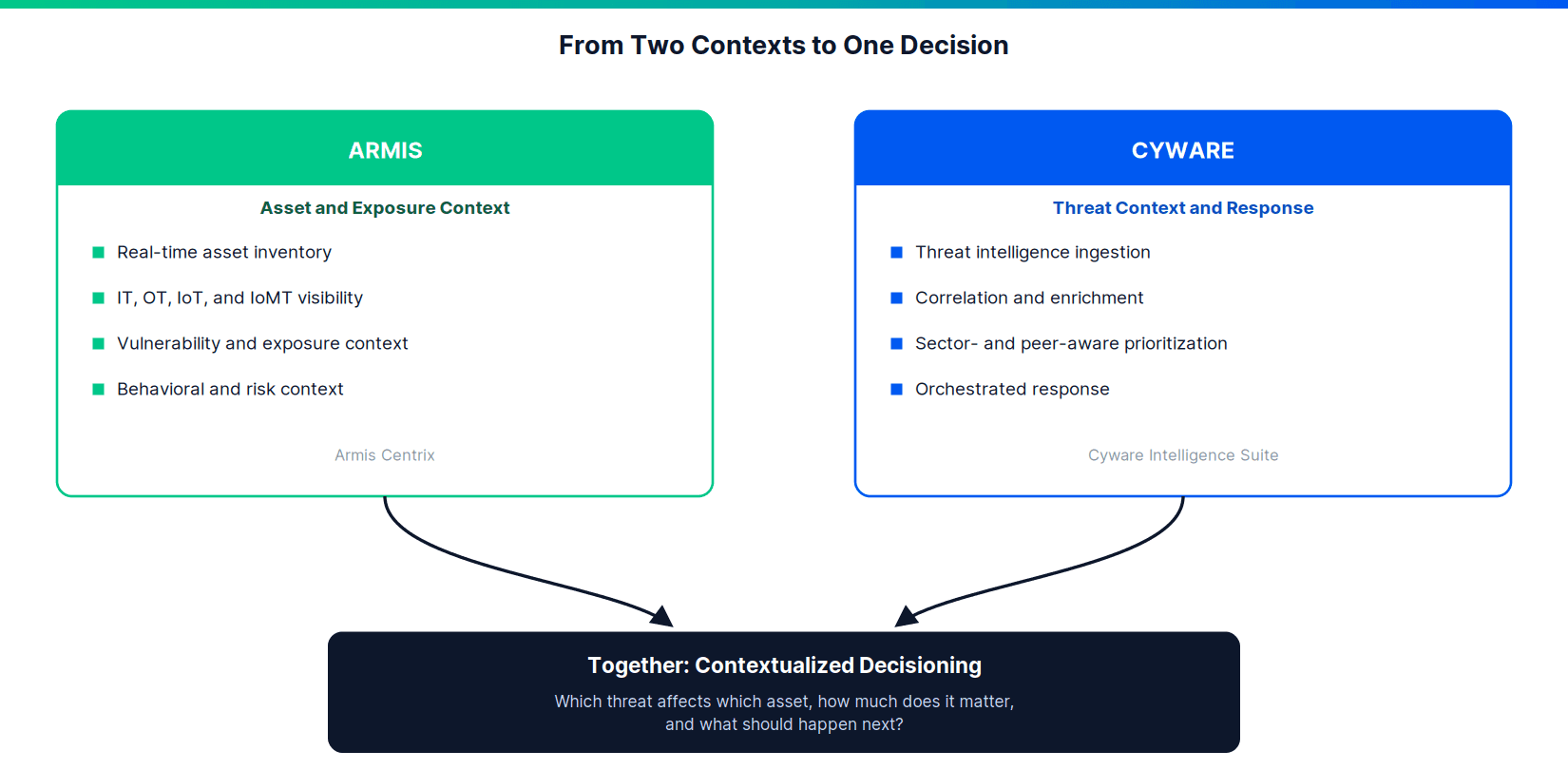
Armis contributes the "what do we actually have and how exposed is it" half of the equation, through continuous, agentless, passive network monitoring. That includes:
A real-time inventory across IT, OT, IoT, and IoMT, including unmanaged and agentless devices that traditional agents never see
Vulnerability context (CVEs mapped to EPSS scores and CISA KEV status), plus ransomware-association and weaponization flags
Behavioral baselines and risk scoring down to the individual device
Crucially, because this discovery is passive and non-intrusive, it works in OT and ICS environments where active scanning risks disrupting sensitive control systems, a constraint that rules out a lot of traditional asset-discovery tooling.
Cyware contributes the "what does this mean and what should happen next" half, through two connected engines:
Intel Exchange ingests and normalizes threat data from commercial feeds, OSINT and dark-web monitoring, ISAC/ISAO sectoral feeds, and internal telemetry, then validates and prioritizes each finding against what actually matters to this organization: is it an active threat for our sector or our named peers, and is it being actively exploited by a threat actor already known to target us, mapping the behavior to frameworks like MITRE ATT&CK along the way.
Cyware Intel Operations layer turns that enriched, prioritized intelligence into action through low-code/no-code playbooks that reach into firewalls, NAC, SIEM, and ITSM systems
How Does the Armis and Cyware Integration Actually Work?
The value of the integration becomes clearest when you follow a single exposure from discovery to verified remediation.
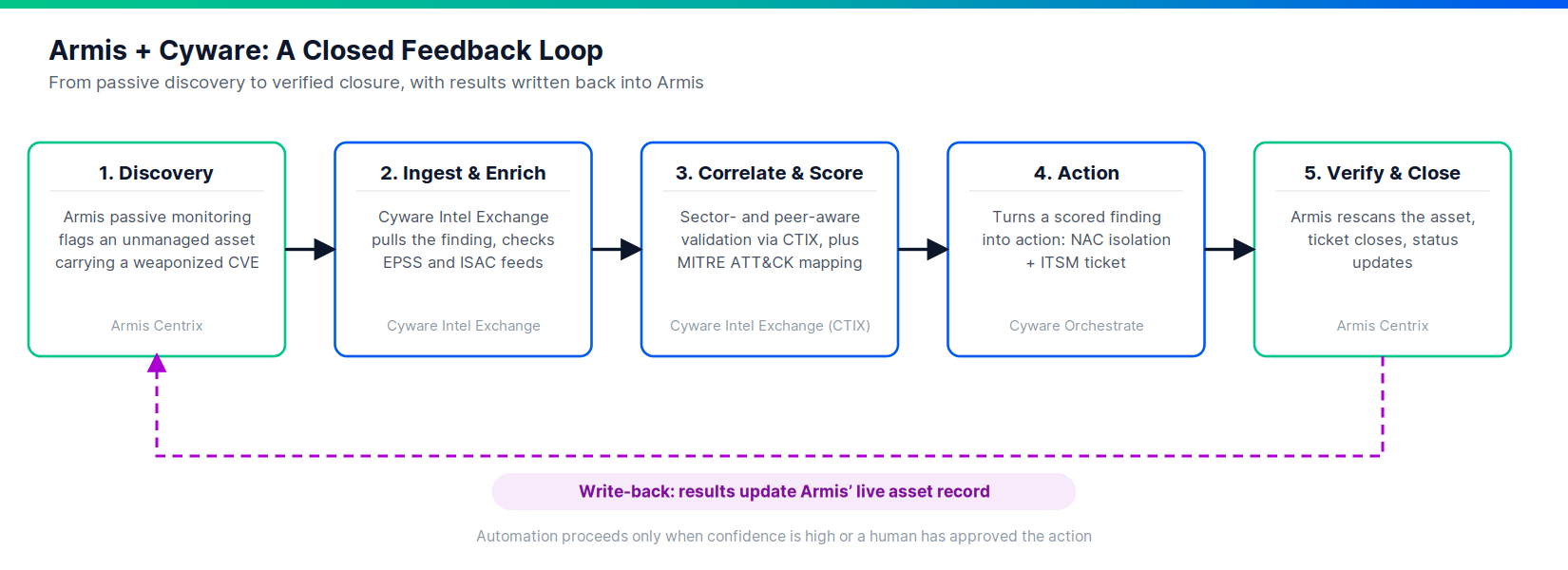
1. Discovery. Armis' passive monitoring identifies an unmanaged OT asset on the network and flags it as carrying a weaponized, ransomware-associated CVE. Because discovery is non-intrusive, this can happen without actively probing the asset or risking disruption to a live control system.
2. Ingestion and enrichment. A Intel Operations playbook, running against an Armis connector, pulls this high-severity finding (device profile, vulnerability data, EPSS score, KEV status) into Cyware Intel Exchange. There, it's checked against EPSS probability thresholds and cross-referenced with external ISAC feeds and commercial threat intelligence to confirm whether this specific CVE is under active, global exploitation right now, not just theoretically dangerous.
3. Correlation and scoring. This is where Cyware Intel Exchange does the work that turns a generic finding into an organization-specific one. It doesn't just confirm the CVE is being exploited somewhere; it checks whether that exploitation is tied to a threat actor already known to target this organization's sector, or one currently active against its named peers, then layers in the organization's own SIEM, EDR/XDR, and historical incident data. A finding that clears all three, asset exposed, CVE actively exploited, and the actor behind it targets this industry, gets a materially different confidence score than one that only clears the first two. That sector- and peer-aware threat context, not just global exploitation data, is what Cyware Intel Exchange adds on top of Armis' asset picture. It's the difference between "this is dangerous somewhere" and "this is dangerous to us, specifically."
4. Orchestrated response. If the evidence clears the confidence threshold the organization has configured, Cyware Intel Operations triggers a targeted playbook: isolating the specific asset through the local NAC, opening an ITSM ticket with the relevant context attached, and pushing updated tags (quarantine status, investigation flags) back into the Armis console. If confidence is lower, the same evidence routes to an analyst for a human decision instead of an automatic action. That governance layer, gating automation on evidence strength or explicit human approval, is what makes speed and control coexist rather than compete. Confidence becomes the control point between intelligence and automation.
5. Verification and closure. Once remediation is applied, Armis rescans the affected asset to validate the fix, the ITSM ticket closes automatically, and the asset's status updates, completing a loop that started with passive discovery and ended with a verified, documented outcome, without an analyst manually shepherding every step.
The architectural detail worth underlining is the write-back. Most integrations move data in one direction: intelligence in, alert out. This model closes the loop.
Armis feeds Cyware with asset intelligence, and Cyware's disposition writes back into Armis, so the asset's live risk posture reflects the response that was just taken. That's what turns a one-time enrichment into a continuously updated source of truth.
What Does Agentic AI Actually Do in This Workflow?
It's tempting, in any conversation about modern security architecture, to treat AI as a headline rather than a function. It's more useful to be specific about what it's actually doing in a workflow like the one above.
This is a human-in-the-loop system by design, not an autonomous one. In a workflow like this one, the agent has four specific jobs, no more and no less:
Correlate. Pull a single exposure against dozens of external feeds, dark-web mentions, and historical incidents in seconds, work that used to consume hours of an analyst's day.
Score confidence. Translate that correlation into a number the rest of the workflow can act on: how sure is the system that this specific asset is at risk, right now.
Explain its reasoning. Surface which intelligence sources contributed to the score and which ATT&CK techniques are implicated, so an analyst can validate the conclusion instead of blindly trusting it.
Recommend, not execute. Propose a next action rather than silently taking it, unless the finding already clears the confidence and governance thresholds the organization has configured.
That division of labor keeps a human in the loop exactly where judgment still matters most: deciding whether an automated response is appropriate for this specific asset, in this specific environment, right now.
The goal is not human-out-of-the-loop automation. It is human-at-the-right-decision-point automation.
What Should Security Leaders Take Away From This?
A few conclusions are worth carrying out of this discussion and into planning conversations.
Context is becoming the unit of security decision-making: A threat indicator or vulnerability has limited meaning without knowing which asset it affects, how exposed that asset is, and what controls surround it.
Identity resolution is the hidden engineering problem: Continuously mapping threat indicators to dynamic assets is harder than simply integrating two APIs. IPs change. Devices move. Assets appear and disappear. The mapping has to remain accurate as the environment changes.
The end state is a closed decision loop. Asset context informs threat prioritization. Threat context drives response. Response outcomes update the asset's risk posture. AI can accelerate that loop, but governance determines where automation stops and human judgment begins.
Finally, the organizations that will outpace their peers over the next several years are unlikely to be the ones with the most feeds or the biggest asset database in isolation. They'll be the ones that have engineered a tight, governed loop between the two: asset visibility feeding threat context, threat context driving prioritized and appropriately automated response, and response outcomes feeding back into an always-current picture of risk.
Context, not volume, is what turns intelligence into defense.
See how the Cyware Intelligence Suite turns asset context into automated response. Explore Now
About the Author
Akshat Jain
CTO and Co-Founder Cyware