


Cyware Intelligence Suite Just Got Sharper: Adversary-Informed Vulnerability Intelligence

Chief Product Officer, Cyware
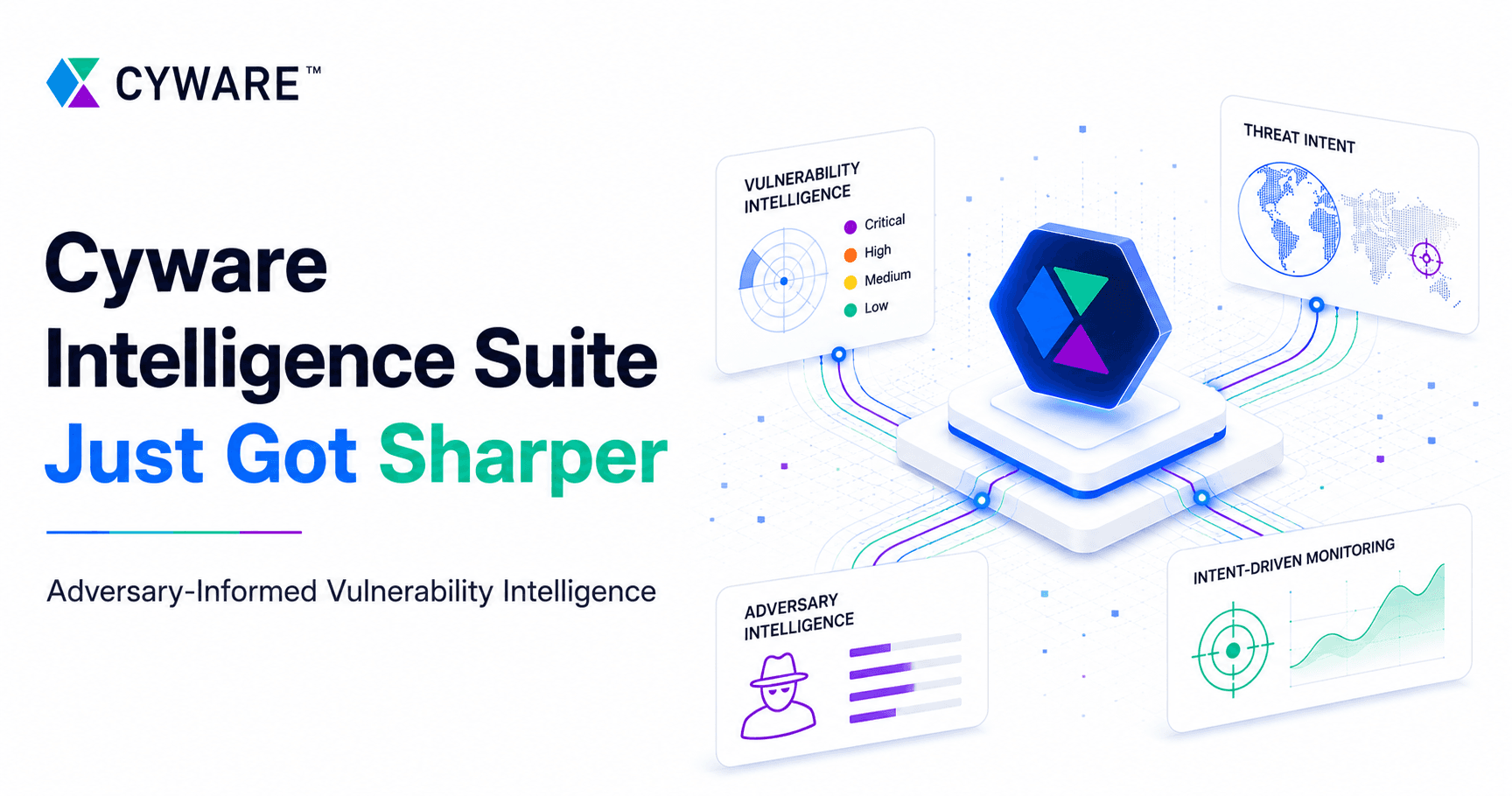
Most security organizations have much of the intelligence they need. Feeds land in one tool. Enrichment happens in another. External exposure sits with a different team. Actioning is manual, or it does not happen. The intelligence is there. The context is fragmented. And the decision it should have informed still gets made without it.
Collecting intelligence is not hard; contextualizing and actioning is. It is further exacerbated when there is intelligence overload.
Cyware Intelligence Suite was built to solve it: one unified threat intelligence management solution, powered by agentic AI, that enables operationalization from ingestion through actioning in a single place. AI agents handle the summarizing, enriching, profiling, and correlating that can consume hours of analyst time. Teams move from intelligence to action in days, not quarters.
Today, we are expanding the Cyware Intelligence Suite by bringing in Cyware Vulnerability Feeds, powered by Securin, another key piece that is essential to providing a cohesive and contextual coverage of intelligence related to an enterprises’ ecosystem.
Cyware Vulnerability Feeds, Powered by Securin
The Problem: A critical need for contextualized vulnerability intelligence
Most enterprises work with static severity scores that may or may not be relevant to them. Furthermore, as we have seen in the past few months adversaries are leveraging AI to discover vulnerabilities at an increasingly alarming velocity. Prioritization becomes key which inherently needs to leverage the enterprise's context. This needs to be followed by appropriate actioning faster than adversaries can exploit them.
Severity scores that enterprises use can often get stale very quickly and enterprises need to move away from solely relying on it. Enterprises need more relevant vulnerability intelligence that also encompasses threat actor context.
What Cyware Vulnerability Feeds Delivers
Cyware Vulnerability Feeds, powered by Securin is a curated, threat-informed vulnerability intelligence data as part of the Cyware Threat Feeds, natively available within Cyware Intel Exchange. It empowers analysts by encompassing four key elements:
Two enriched STIX object types. Vulnerability and Threat Actor objects, queryable in the same graph as the indicators, reports, malware, and actors your team already tracks. Not a separate console. The same graph.
Multi-signal risk scoring. CVSS v2, v3, and v4, EPSS, and the proprietary Cyware Risk Index side by side, alongside exploitation flags for exploited in the wild, proof of concept available, CISA Known Exploited Vulnerabilities catalog inclusion, weaponized, and fix available. One vulnerability, several independent signals, ranked by the one that reflects real-world risk rather than theoretical impact.
Adversary linkage. Every CVE connected to the threat actors exploiting it, the TTPs those actors use, the malware and tooling involved, and the industries and countries they target. The link runs both ways, so an analyst can pivot from a vulnerability to its adversaries or from an adversary to its full vulnerability arsenal.
Lifecycle and asset context. The complete disclosure-to-exploitation timeline, affected products and packages, and CPE and PURL identifiers so intelligence maps cleanly onto an actual asset estate.
What Changes Inside the Platform
Analysts can now leverage vulnerability intelligence in addition to all the other threat intelligence data in Cyware Intel Exchange to operationalize the entire lifecycle. Furthermore, they can use AI agents and playbooks within the natively available Cyware Orchestrate Intel Operations to power a range of use cases.
Correlation at rest. Every incoming vulnerability is instantly correlated against actors, malware, and ATT&CK techniques already tracked in Cyware Intel Exchange. The enrichment is not a task in a queue. It is the state the data arrives in.
Threat actor profiles that stay current on their own. Existing actor records are automatically back-linked with the vulnerabilities they exploit, so an actor assessment that used to start with an hour of open-source research starts with the relationships already drawn.
Convergence between threat intelligence and vulnerability management. These two teams have historically answered adjacent questions with different data. Cyware Vulnerability Feeds answers the question that sits between them: do the vulnerabilities powering an active adversary group overlap with what we have not patched yet? That question has been asked in every quarterly review. It has rarely been answerable in a single view.
Earlier warning. Trending and proof-of-concept signals surface emerging threats days to weeks ahead of mass exploitation. That window is the entire difference between a planned patch cycle and an incident bridge.
Example Use Cases to help Security Teams
Prioritized patching. One triage surface for every incoming CVE, filtered by exploitation status, KEV inclusion, trending signals, actor and ransomware linkage, and EPSS, sorted by Cyware Risk Index, with standing views saved for recurring review.
Malware and ransomware linkage. A queryable map of malware and ransomware families to the vulnerabilities they depend on.
Threat actor to attack surface mapping. Who is likely to target you, and where you are genuinely exposed to them.
Early warning on emerging threats. Newly disclosed CVEs and exploitability trends, paired with the threat intelligence that gives them meaning.
ATT&CK technique mapping. A bidirectional bridge between techniques and vulnerabilities for threat hunting and detection engineering.
In Practice: Contextualizing Vulnerability Intelligence to Your Attack Surface
To solve the critical need of understanding vulnerability relevancy to the enterprise ecosystem, analysts inside the Cyware Intelligence Suite can run native and custom playbooks to:
Identify relevant threat actors. Filter the intelligence feed to actors matching your risk profile, for example those targeting the financial sector in the United States with a known country of origin.
Compile the actor list. The playbook assembles the matching actors automatically and pivots straight into enrichment.
Enrich with vulnerabilities. Pull the vulnerabilities associated with each actor, updated within the last 24 hours, rather than working from stale CVE mappings.
Check real exposure. Test those vulnerabilities against scan results from Qualys or Tenable to determine what is actually present in the environment.
Consolidate and distribute. Deliver actor-associated vulnerabilities and affected assets in a single correlated report, routed to the teams who own the remediation.
Analysts can perform this with no need to manual pivot between four tools etc. decreasing operational complexity and TCO, and additionally, create an output that a vulnerability management team can act on the same day. Analysts can also, if allowed by the enterprise's operational procedure, take action to remediate the vulnerability in an automated manner. In this scenario, Cyware Intelligence Suite empowers contextualized & adversary-informed prioritization by bringing in intelligence, the exposure data, and the orchestration layer live in a unified manner.
Smooth and Native Availability: Cyware Vulnerability Feeds in an Already Comprehensive Suite
This will be natively available and a part of Cyware Intelligence Suite in addition to already powerful capabilities such as: .
Cyware Intel Exchange (Threat Intelligence Platform): a centralized and automated threat intelligence platform that aggregates, correlates, and scores massive datasets to enable real-time action.
Cyware Threat Feeds: curated, sector-specific threat intelligence streams, available out of the box, designed to deliver high-signal, actionable visibility directly into enterprise defensive ecosystems.
Cyware Digital Risk Protection: an external threat monitoring solution, powered by SOCRadar, that continuously scans the dark web and open sources to preemptively neutralize brand abuse and account takeovers.
Cyware Exposure Management: an integrated system that connects credential exposures with active malware and adversary tactics to accelerate investigations.
Cyware Malware Sandbox: a native, multi-engine detonation environment that extracts deep behavioral insights from suspicious files to supercharge advanced threat hunting.
Cyware Orchestrate Intel Operations: an orchestration engine that operationalizes threat intelligence by automating defensive actions, optimizing analyst workflows, and accelerating incident response.
This is a true Unified Threat Intelligence platform. Cyware AI further enhances it and allows security team members to view and operationalize threat intelligence holistically.
Continuing evolution of Cyware Intelligence Suite
As we keep reviewing the evolving needs of security teams, we continue to bring in key capabilities to enhance Cyware Intelligence Suite with a sharp focus on being AI native, operationalization, contextualization and actioning.
Stay tuned as we continue to bring in more security team oriented capabilities involving intent, relevancy, contextualization, AI, actioning and dissemination.
Ready to see it? Book a demo and we will walk your team through adversary-informed vulnerability prioritization and intent-driven monitoring inside Cyware Intelligence Suite, using your sector and your threat profile.
About the Author
Sachin Jade
Chief Product Officer, Cyware