


The End of Static Playbooks: Why Agentic AI is the New Security Operating System

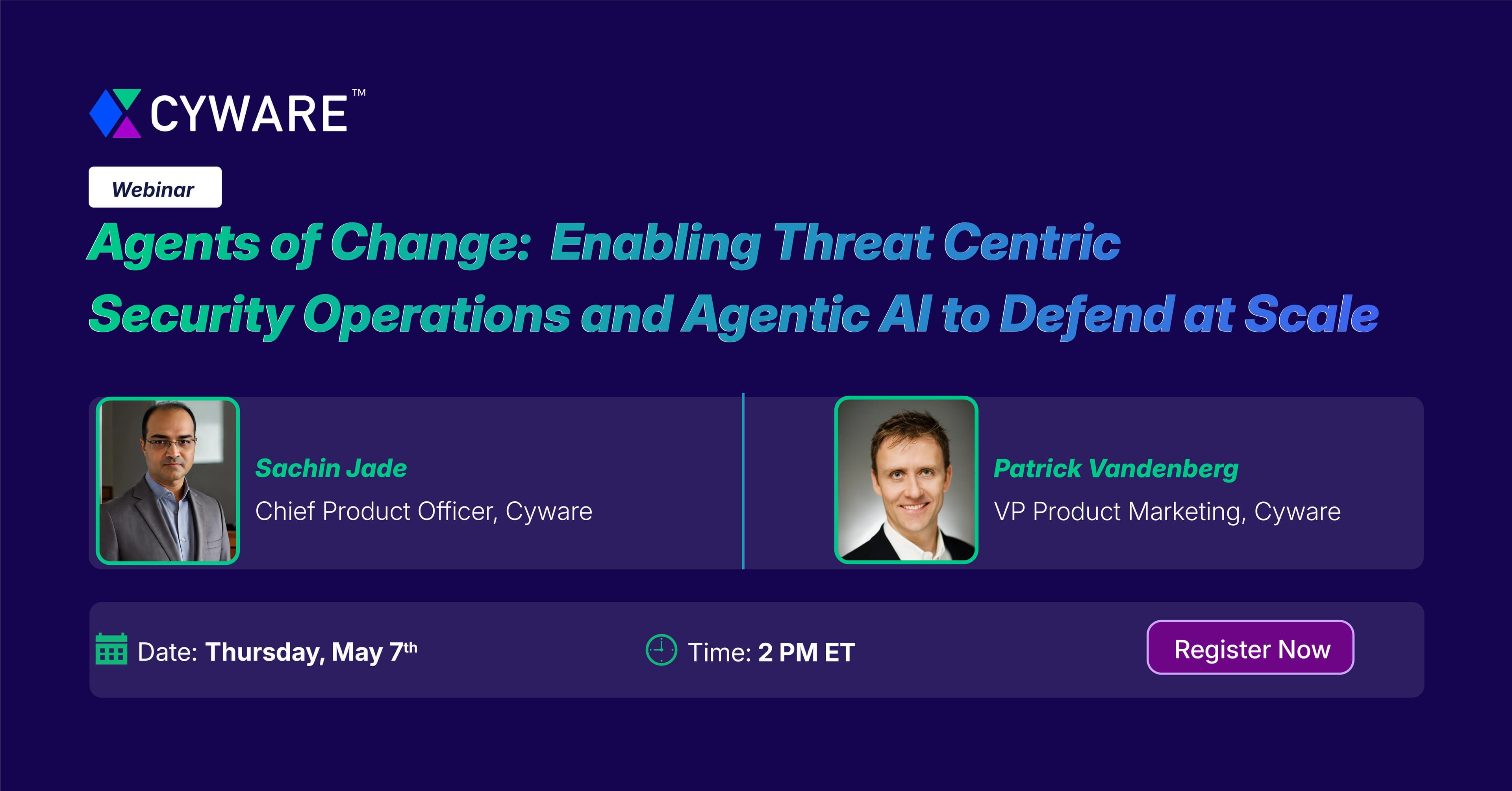
The security operations center is reaching a breaking point. For years, we have relied on a more is better philosophy: more tools, more feeds, and more analysts. Yet, as digital ecosystems expand, the speed of modern attacks has far outpaced human processing power. On May 7, 2026, Cyware will host a live session, Agents of Change: Enabling Threat Centric Security Operations and Agentic AI to Defend at Scale, to address the 2026 mandate: moving from AI as a feature to the primary Cyware AI Security Operating System.
The Failure of Legacy Automation
The industry is currently flooded with agent washing where legacy automation tools are simply rebranded as AI. Traditional SOAR platforms are built on static, if-this-then-that scripts. These playbooks are fragile; they crumble the moment an attacker deviates from a predicted path.
According to the latest Gartner research (April 2026), the shift is no longer optional. Gartner predicts that by 2029, vendors lacking embedded agentic AI capabilities will be displaced by platforms that deliver autonomous or semiautonomous cyberthreat intelligence operations. The era of the feed-centric platform is over; the era of Unified Cyber Risk Intelligence (UCRI) has arrived.
From Analyst to Mission Commander
The most interesting shift in 2026 isn’t just the technology; it’s the change in the human role, a sentiment echoed by security professionals at RSAC 2026 who highlighted the urgent need for a threat centric approach.
In a traditional SOC, you spend hours manually stitching logs. In an Agentic SOC, you give a mission: Monitor for lateral movement targeting the SQL database and prevent data exfiltration. Taking it one step further, in a threat centric security operations paradigm, analysts and operators leverage goal oriented agents to identify what threats are relevant to them and conduct their process & procedures accordingly improving their signal to noise ratio and decreasing TCO.
When a particular threat is being considered or detected, analysts can leverage the analysts to find the context, understand the risk, identify the behavior and evaluate the defensive approach. Furthermore, threat hunting via agents provide cybersecurity teams to identify the coverage, become proactive and establish the correct defensive postures.
How Real Time Data Ends Manual Decision Making
What makes these agents different from old school automation? The answer lies in how they consume data and reason through problems, as explored in our deep dive on the AI agent ecosystem and its operational impact
Dynamic Reasoning: Agents use reasoning loops to adapt to live attacker behavior in real time.
Real Time Threat Intel: Intelligence is no longer a passive report. It becomes the agent’s instinct, allowing the system to predict and understand behavior as it happens.
Guardrails and Accountability: Autonomy does not mean a lack of control. Modern security architects implement safety guardrails to enable safe autonomy at scale.
Experience a Live Agentic AI Demo
During our upcoming webinar, Cyware Chief Product Officer Sachin Jade and VP of Product Marketing Patrick Vandenberg will bridge the gap between theory and reality. To see a preview of how these systems function, you can watch our latest AI agent video before joining us for the full live demonstration.
We will show you something special: how agents reason, correlate, contextualize and coordinate across different threat intelligence objects & relations. You will see goal driven agents acting in an autonomous manner to help the analysts with their objectives.
Security Operation Evolution: Enabling a Threat Centric Agentic AI SOC
We believe that Threat Centric Security Operations is critical for the evolution of SOC. This enables the operations team to focus on threats that are “relevant” to them. Threat Centric Agentic AI supercharges it to perform at scale.
Join us to see how your team can scale without adding headcount by shifting from manual execution to strategic mission control.
Webinar Details:
Date: 7th May 2026
Time: 2:00 PM ET
Duration: 60 Minutes
About the Author