


Cyware Expands the Intelligence Suite with Digital Risk Protection — Here's Why It Matters

CTO and Co-Founder Cyware
Key Takeaways
Modern attacks begin outside the perimeter, long before anything trips a SIEM alert. Cyware DRP closes that blind spot by turning external risk signals into automated, intelligence-driven defense.
Your biggest risk sits outside the perimeter. Leaked credentials, lookalike domains, and fake executive profiles are staged weeks ahead of an attack and inward-facing tools like SIEM, EDR, and IAM never see them.
DRP's real gap is operationalization, not detection. Most tools surface external threats as alerts but can't tell you whether one is an active threat or just noise. Visibility alone isn't enough.
Cyware DRP, powered by SOCRadar, embeds external exposure into Cyware Intel Exchange. Lookalike domains, dark web leaks, brand abuse, and takedowns all get correlated with live campaigns and wired into automated playbooks.
The shift is from "detect and respond" to "predict and prevent" — and the value reaches beyond the SOC, giving CISOs board-level metrics, SOC/CTI teams less alert fatigue, and fraud and legal teams takedown documentation.
Cyware DRP is available now as an add-on module within the Cyware Intelligence Suite.
Introduction
Picture this. Somewhere on a dark web forum right now, an employee's corporate credentials are listed for sale alongside a screenshot of a stealer log. A lookalike domain, registered three weeks ago, has been quietly sitting idle waiting to be weaponized. On LinkedIn, a fake executive profile is accumulating connections. None of these have triggered a single alert in your SIEM. None of them are inside your perimeter.
This is how modern attacks start. Not with a breach, but with preparation. And by the time most security teams find out, the attacker has already done the groundwork.
Today, Cyware is announcing the expansion of the Cyware Intelligence Suite adding Cyware Digital Risk Protection (Cyware DRP), powered by SOCRadar. Through this strategic partnership, Cyware is bringing Digital Risk Protection into its platform, operationalizing SOCRadar's external visibility within Cyware's intelligence backbone to transform standalone DRP signals into automated, intelligence-driven defense. Enterprises and MSSPs can now correlate external exposures with live threat campaigns, prioritize risk with real-world context, and trigger automated defensive playbooks in real time.
Why Is Your Biggest Security Risk Now Outside the Perimeter?
Most security budgets flow inward: EDR, SIEM, IAM, next-generation firewalls. These tools are built to watch what happens inside the network. They are not built to watch what threat actors are doing before they ever attempt to get in.
Before adversaries launch an attack, they conduct reconnaissance. They map public-facing infrastructure, scrape employee credentials from paste sites, register convincing lookalike domains, and build out external threat scaffolding weeks or months ahead of any intrusion attempt. By the time a threat actor acts, they have already robbed the organization of the initiative.
Digital Risk Protection closes that gap. DRP provides continuous monitoring of an organization's external digital environment to detect, analyze, and remediate threats that exist outside the enterprise perimeter, across the surface web, deep web, and dark web.
Why Isn't Digital Risk Protection Monitoring Enough on Its Own?
The market gap in DRP is not detection. It is operationalization.
Many DRP tools are effective at discovering external threats and surfacing them as alerts. But what’s been lacking is the intelligence enrichment, workflow automation, and ecosystem integration needed to act on those alerts at speed. The result is a familiar problem: monitoring without intelligence leaves the most important question unanswered. Is this an active threat targeting our organization right now, or background noise?
Without context, analysts cannot tell whether a leaked credential is already being used in an active campaign, whether a lookalike domain is part of a broader phishing operation targeting their sector, or whether the threat actor behind a social media impersonation is the same group behind a ransomware listing elsewhere. Visibility alone is insufficient. The value is in what you do with it.
This is exactly where the Cyware Intelligence Suite changes the equation. By embedding DRP within Cyware Intel Exchange, every external exposure can be immediately correlated with live threat campaigns, prioritized with real-world context, and routed into automated defensive playbooks. Organizations can correlate external exposures with active threat campaigns, operationalize intelligence across the security stack, prioritize risks based on real-world threat context, and move from reactive detection to proactive prevention.
What Is Cyware Digital Risk Protection and What Does It Include?
Cyware DRP is a new module within Cyware Intelligence Suite, powered by SOCRadar. It extends the suite's unified threat intelligence management program beyond the perimeter into the external attack surface: dark web channels, domain infrastructure, social media, and credential exposure markets.
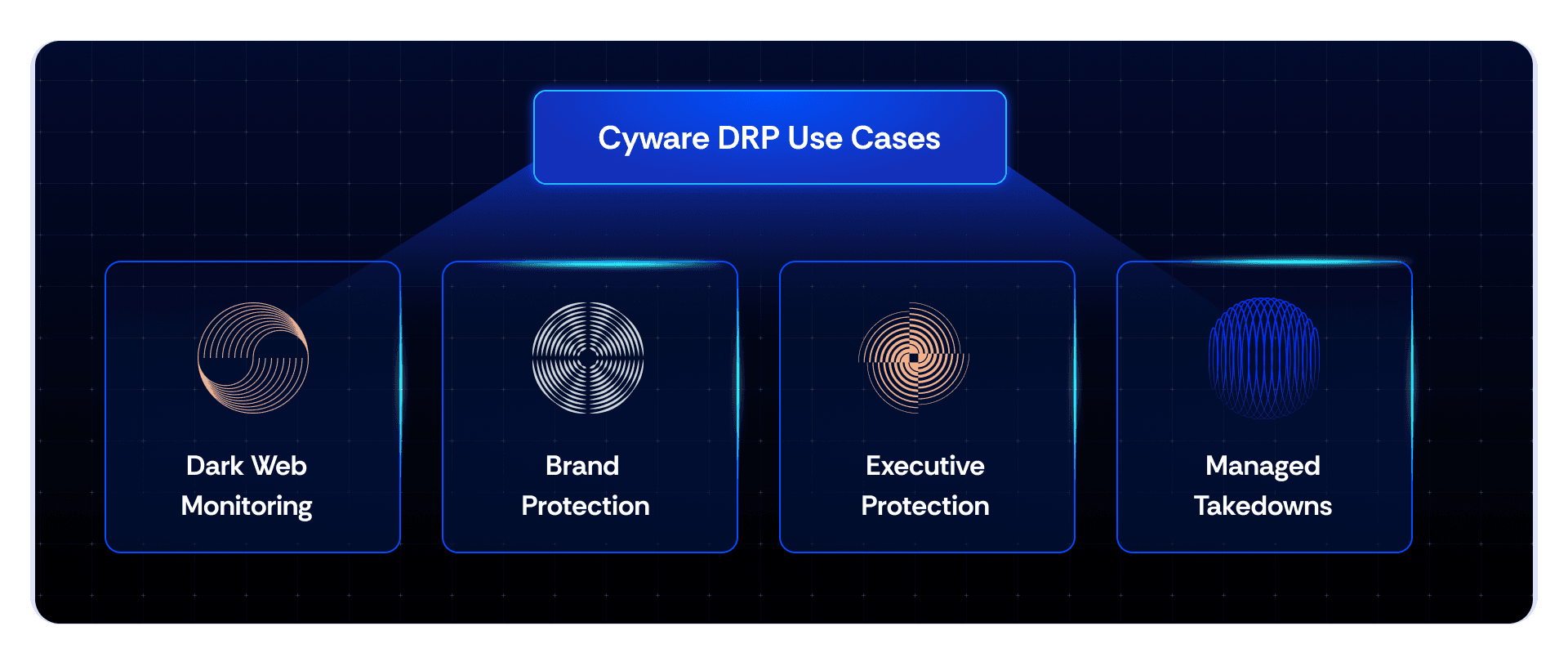
The enhanced Cyware Intelligence Suite with Cyware DRP delivers continuous visibility and operational response across several high-impact areas:
Domain Impersonation Defense
Automatically ingest external lookalike domain alerts, instantly running automated playbooks to block malicious URLs across perimeter security controls.
Unified Dark Web Containment
Correlate external deep web leaks with internal assets dynamically, triggering automated identity session resets to stop unauthorized access.
Coordinated Brand Abuse Response
Ingest external social media alerts, automatically routing discovered executive impersonation findings straight into centralized security orchestration playbook workflows.
Managed Takedown Services
Streamlined, analyst-led escalation to neutralize malicious infrastructure directly from the Cyware interface, eliminating manual overhead for security teams.
How Does Cyware Turn External Threat Detection Into Automated Response?
Consider a concrete example. SOCRadar identifies a phishing domain impersonating a customer-facing login portal. That signal flows into Cyware Intel Exchange. A playbook triggers automatically: high-confidence indicators of compromise are distributed across the security stack, blocking access at the SIEM, SOAR, EDR, and firewall layers while a managed takedown is simultaneously initiated to remove the domain.
Now consider a credential leak. SOCRadar surfaces a fresh stealer log entry with a corporate email address on a dark web marketplace. The alert is ingested into Cyware Intel Exchange. A playbook queries the IAM provider to verify the user's status, cross-references the leak with known stealer log campaigns already in the platform, and if the credential is confirmed active, initiates a password reset or OAuth token revocation. The SOC receives a prioritized ticket with full context attached.
Both scenarios move from detection to resolution without manual escalation. That is the shift from "detect and respond" to "predict and prevent." By combining SOCRadar's DRP capabilities with Cyware's ability to manage and operationalize intelligence, organizations achieve unified threat intelligence management that covers external risk end-to-end.
Who Benefits From Digital Risk Protection Within the Cyware Intelligence Suite?
CISOs gain quantifiable external risk visibility with a direct path to remediation, and the board-level metrics needed to demonstrate security program value: credentials found, impersonation attempts detected, phishing pages taken down.
SOC and CTI teams receive prioritized, enriched intelligence correlated against the broader threat landscape already present in Intel Exchange, reducing alert fatigue and allowing analysts to spend time responding rather than triaging.
Fraud, brand, and legal teams benefit from takedown documentation, impersonation alerts, and credential exposure data that directly support their mandates, making this one of the few security investments that delivers value well beyond the SOC.
How Do You Get Started with Cyware Digital Risk Protection?
Cyware Digital Risk Protection is available now as an add-on module within the Cyware Intelligence Suite. Cyware DRP transforms Digital Risk Protection from a standalone visibility tool into an integrated, intelligence-driven security capability.
The question is not whether your organization needs external threat visibility. The question is how fast you operationalize it.
Request a Demo | Explore the Cyware Intelligence Suite
People Also Ask
Q1: Why do traditional SIEM and EDR tools miss external digital risks?
Traditional SIEM and EDR tools only monitor activity inside the corporate network. They miss external threats because attacker reconnaissance, such as registering lookalike domains, spoofing VIP profiles, or selling stolen credentials on the dark web, occurs entirely outside the enterprise perimeter.
Q2: What is Cyware Digital Risk Protection (DRP)?
Cyware Digital Risk Protection (DRP) is an exposure management module powered by SOCRadar. It integrates external threat visibility directly into the Cyware Intel Exchange, allowing teams to correlate dark web and surface web exposures with live threat campaigns to trigger automated defenses.
Q3: What areas does Cyware Digital Risk Protection monitor?
Cyware DRP provides continuous visibility and automated mitigation across four primary areas:
Brand & Domain Impersonation: Lookalike domains and phishing infrastructure.
Dark Web Monitoring: Leaked corporate credentials and stealer logs.
Executive Protection: Doxxing and threat actor chatter targeting VIPs.
Social Media Brand Abuse: Fake corporate accounts and rogue mobile apps.
Q4: Who benefits from integrating DRP into the Cyware Intelligence Suite?
CISOs: Gain board-level metrics on blocked external risks and neutralized threats.
SOC & CTI Teams: Experience less alert fatigue due to automated intelligence correlation.
Fraud & Legal Teams: Receive automated takedown documentation to protect brand reputation.
About the Author
Akshat Jain
CTO and Co-Founder Cyware