


Cyware AI Agents Are Here: Bringing Agentic AI to Threat Intelligence Workflows

CTO and Co-Founder Cyware
Ask any threat intelligence or security analyst what their day looks like, and the answer is startlingly consistent: an endless rotation between browser tabs, dashboards, threat feeds, SIEM consoles, ticketing systems, and reporting tools. Not because they want to context-switch, but because every step of triage, investigation, and documentation demands a different tool.
It is not that AI has not tried to help. Chat-based assistants have given analysts a faster way to ask questions. But answering a question and taking action on that answer are two completely different things. Traditional AI tells you what it found. Agentic AI plans, executes, validates, and adapts from a single console, right inside the workflows where your team already operates. That is exactly what Cyware AI delivers.
"Security analysts waste hours switching between tools, reports, and dashboards to triage alerts, analyze intelligence, and document incidents. Cyware AI changes this."
What Cyware AI Is Built On
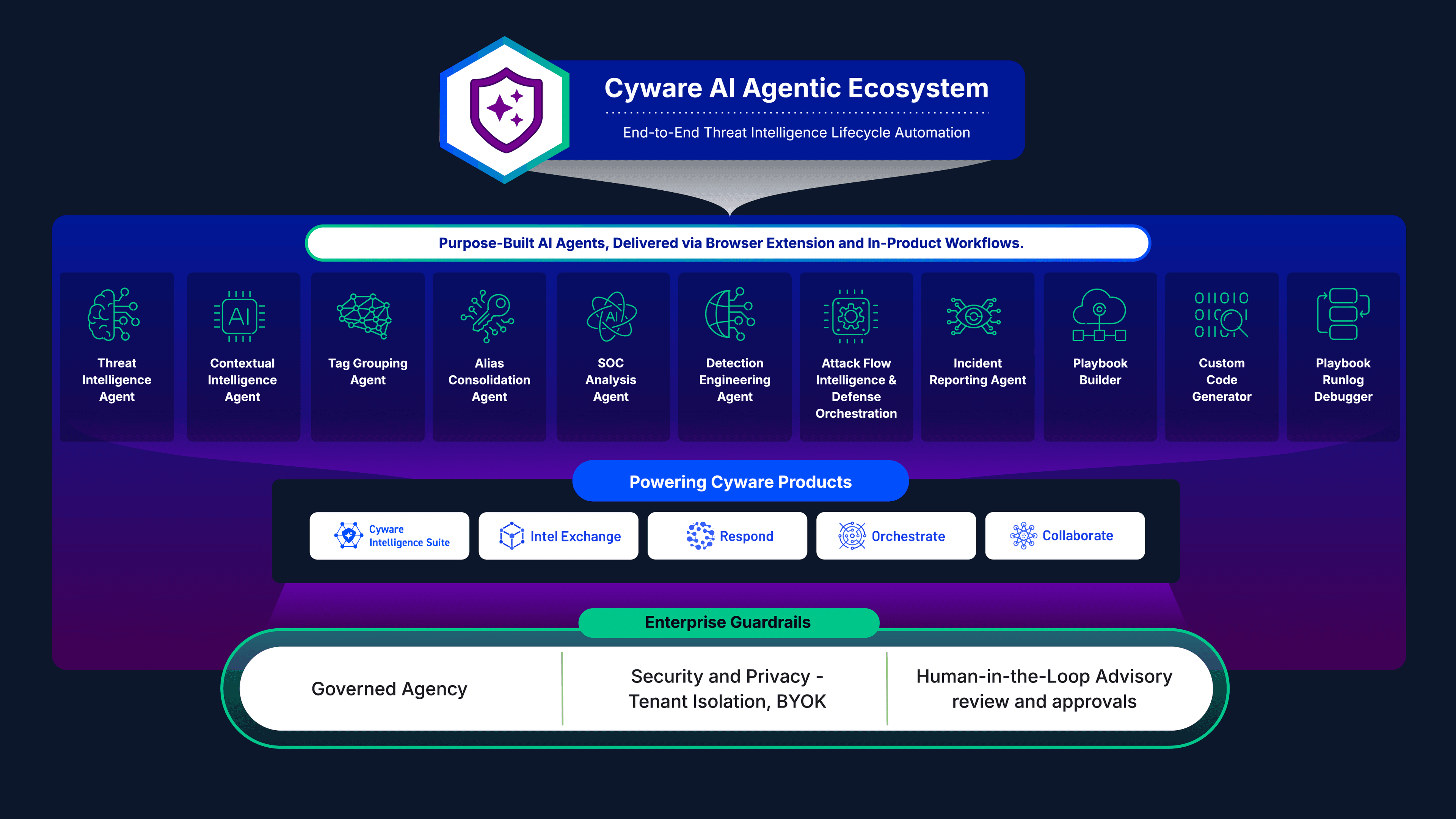
Cyware AI delivers purpose-built AI agents capable of planning, executing, validating, and adapting cybersecurity tasks directly where analysts already work. Agents are available via a Chrome browser extension and natively inside Cyware products as an in-product floater, surfacing on demand without disrupting existing workflows. These agents are built directly into Cyware Intel Exchange, accessible via a browser extension and natively inside your products through the Agent Hub, with Cyware Orchestrate powering agentic workflows silently in the background so analysts work in natural language rather than playbooks and pipelines.
The backend is purpose-built for enterprise: powered by OpenAI, Gemini, and Anthropic models, with tenant isolation, governance controls, and a zero-local-storage architecture. This is not a prototype. It is an enterprise-grade agentic platform built to scale with your team from day one.
Meet the Cyware AI Agents
Cyware AI launches with a collection of agents that will continue to expand, all purpose-built to target the most painful points in daily SOC and threat intelligence operations.
Threat Intelligence Agent
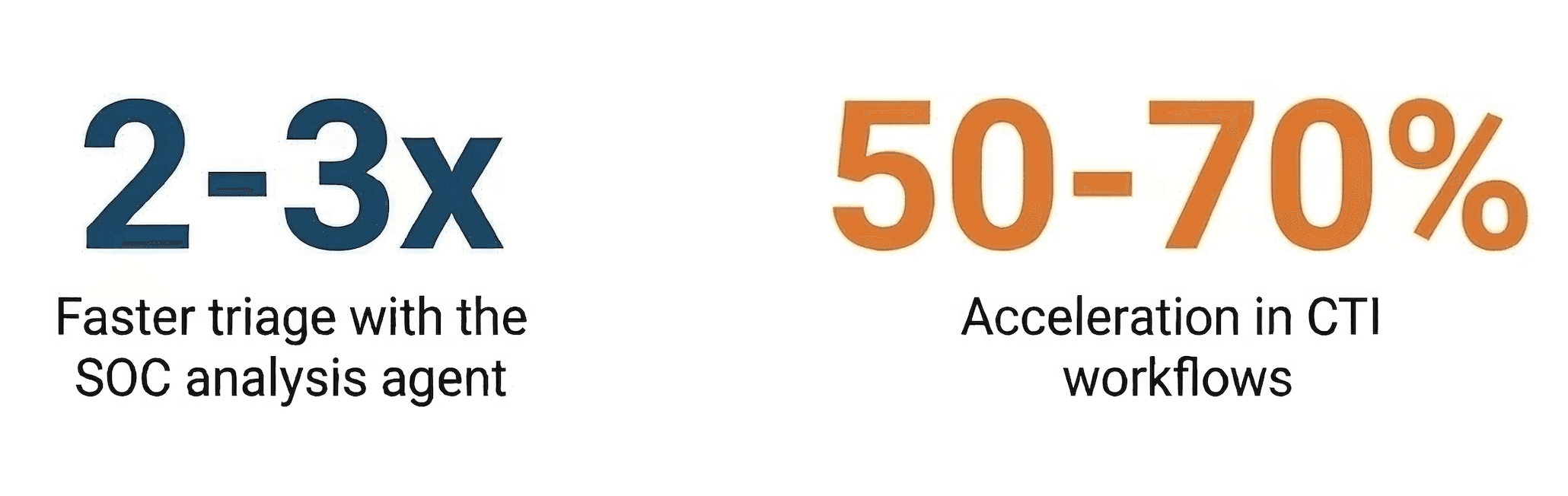
Intelligence workflows are notoriously labor-intensive. This agent summarizes threat reports and feeds, enriches indicators of compromise, profiles threat actors and malware families, suggests relations and metadata tags, and assesses relevancy against your environment, accelerating CTI workflows by 50-70% without sacrificing analytical depth.
Incident Reporting Agent
This agent converts raw incident context into structured executive summaries, post-incident reports, and audience-tailored communications in a fraction of the time it takes manually. Reporting becomes consistent, fast, and standardized across the team, freeing analysts for higher-value investigative work.
Detection Engineering Agent
Bridges the gap between threat discovery and active defense. This agent analyzes the full threat intel context including IOCs, TTPs, and malware behavior to automatically generate production-ready threat defence library rules and validated SIEM queries. Before deployment, analysts can validate rule efficacy against real-world Splunk data, ensuring faster detection coverage with minimal manual toil.
Alias Consolidation Agent
The same threat actor can appear under dozens of different names across vendor reports, creating fragmented intelligence and skewed risk metrics. This agent detects and groups entity aliases across sources using semantic similarity, TTP fingerprinting, and historical overlap, ensuring that scoring, investigations, and rules always treat a threat entity as a single logical unit.
Attack Flow Agent
Threat intelligence delivered as lists of indicators tells analysts what was found, not how an attack unfolded. This agent transforms static intelligence and siloed incident logs into dynamic, machine-readable adversary behavior sequences, allowing analysts to visualize, chain, and predict attacker actions from initial access to final impact, shifting defense from reactive to proactive.
Contextual Intelligence Agent
Raw threat data without context forces analysts to manually piece together the full picture across multiple sources before any action can be taken. This agent acts as the cognitive engine of your threat intelligence platform, automating technical summaries and proactively suggesting tags, metadata, and cross-entity relationships so analysts instantly understand the full scope of any threat object.
Tag Grouping Agent
Inconsistent tagging and complex query syntax slow down both new and scaling intelligence teams. This agent automates the creation and maintenance of a tailored intelligence structure by suggesting industry-relevant tags, building dynamic tag groups, and translating natural language requests into precise Cyware Query Language queries, so any analyst can surface specific intelligence without mastering complex syntax.
SOC Analysis Agent
Triage does not have to be manual. This agent zeros in on relevant assets, enriches IOCs automatically, connects the dots between disparate alerts generated across SIEMs, EDRs, and ticketing systems, and surfaces step-by-step mitigation guidance without requiring analysts to jump between tools. It cuts triage cycles by 2-3x while maintaining full audit trails and zero local data exposure.
Connecting The Power of AI Agents to Analyst Workflows
The benefit of Agentic AI in key threat intelligence and security workflows is clear. But analysts still control the system. That’s what Cyware AI has created the Agent Hub - an analyst workbench to manage and deploy selected agents into the key workflows that the analyst deems necessary. Cyware AI Agent Hub is available in-product or as a browser extension. Security analysts already live in their browsers. Chrome and Edge are the surfaces where alerts are reviewed, intelligence feeds are consumed, and incident tickets are opened. By meeting analysts exactly where they work, Cyware AI eliminates the single biggest barrier to AI adoption: workflow disruption.
Unlike standalone AI tools that require context-switching, Cyware AI agents run in-context. They see what the analyst sees, integrate with the underlying Cyware APIs, and execute actions without requiring any manual copy-paste or re-entry of data. The abstraction is complete: Cyware Orchestrate playbooks, Cyware Intel Exchange enrichment logic, and Cyware Respond case management all surface through natural language.
For security leaders, this architecture also delivers governance-first benefits. No data is written locally. Every agent action is logged and auditable. The multi-model backend spanning OpenAI, Gemini, and Anthropic is isolated per tenant, ensuring enterprise-grade data separation without compromising performance.
Who Benefits from Cyware AI Agents
CISOs and Security Leaders
Faster response without proportionally larger teams, consistent reporting for executive and board audiences, and agentic AI that operates within your governance guardrails from day one. The ROI case is straightforward: 2-3x triage acceleration and 50-70% CTI workflow improvement on top of existing cloud licenses.
SOC and Threat Intelligence Teams
Alert fatigue is real. Manual enrichment is exhausting. Inconsistent reporting creates organizational friction. Cyware AI agents address each of those pain points with purpose-built, auditable, always-available intelligence that speaks your language and integrates with your stack.
Detection Engineers
Stop spending hours converting threat reports into detection logic manually. The Detection Engineering Agent synthesizes IOCs and TTPs into production-ready rules, validates them against live Splunk data, and enables instant distribution to member organizations.
The Bigger Picture
Agentic AI is not a future category. It is the direction in which the entire security industry is moving. The question for every SOC team is not whether AI agents will be part of their operations, but which agentic platform will define their workflows.
Cyware AI is built on a clear philosophy: agents should be purpose-built, not generic. They should enhance human efficacy and judgement, not replace it. They should operate where analysts already work, not demand a new paradigm. And they should carry enterprise governance from the first day of deployment, not as an afterthought.
Cyware AI launches with an initial collection of agents available now, with more expanding the suite going forward. From triage and intelligence all the way to detection engineering, behavioral analysis, and taxonomy management, every stage of the intelligence-to-defense pipeline is covered, agentic, auditable, and accessible to every skill level on your team.
The SOC does not live in one place. Neither does Cyware AI. See Cyware AI in action. Request a demo at cyware.com.
FAQ
Q1: What is the Agent Hub?
A workbench-like facility available to analysts to work with and manage agents. It is available in two forms:
In-product - accessible directly within the Cyware platform interface.
Browser extension - accessible via the browser agent capability.
The Agent Hub allows analysts to coordinate and drive selected agents across various workstreams. It is the central management point for the entire agent portfolio.
Q2: How do agents actually work, what makes them "agentic"?
Standard AI tools respond to a prompt and stop. Agentic AI goes further, it plans a sequence of steps to complete a task, executes each step, validates the output, and adapts if something unexpected comes up. Cyware's agents do this across real security data and real Cyware product APIs. The analyst sets the task, the agent handles the execution pipeline, and the analyst reviews and acts on the structured output. Human judgment stays in the loop; the agent handles the multi-step work in between.
Q3: What AI models power the agents?
The backend uses a multi-model architecture drawing on OpenAI, Google Gemini, and Anthropic models. This is not a single-model dependency Cyware's platform selects the appropriate model based on the nature of the task, giving flexibility and resilience across different types of agent work.
Q4: Can agents be used outside the Cyware platform?
Yes. The browser extension is specifically designed for this. An analyst reviewing an external threat report in their browser, or working in a third-party SIEM, can use the Agent Hub via the extension to run agents without switching back to the Cyware platform. The agents still connect back to the customer's Cyware deployment via API.
About the Author
Akshat Jain
CTO and Co-Founder Cyware